The first participant implanted with Paradromics' Connexus BCI, a Michigan woman in her sixties with a progressive motor neuron disease, used it for unscripted real-time speech and text — choosing her own words, answering open questions, and talking to her grandchildren by phone. Paradromics also reports separating the neural signatures of attempted and imagined speech.
Paradromics — Connexus, Connect-One early feasibility study — The first participant implanted with Paradromics' Connexus BCI — a Michigan woman in her sixties with a progressive motor neuron disease — used it for unscripted, real-time speech and text. The distinction from earlier speech neuroprostheses is what she was doing: not copying researcher-selected phrases but choosing her own words, answering open questions, and talking to her grandchildren on a live phone call. Paradromics also reports separating neural signatures for attempted speech, where the person tries to produce sound, from imagined speech, where language is generated internally without any attempt — two different control signals from one implant. This is one participant in an FDA-IDE early feasibility study, and accuracy, vocabulary and durability figures have not been published.
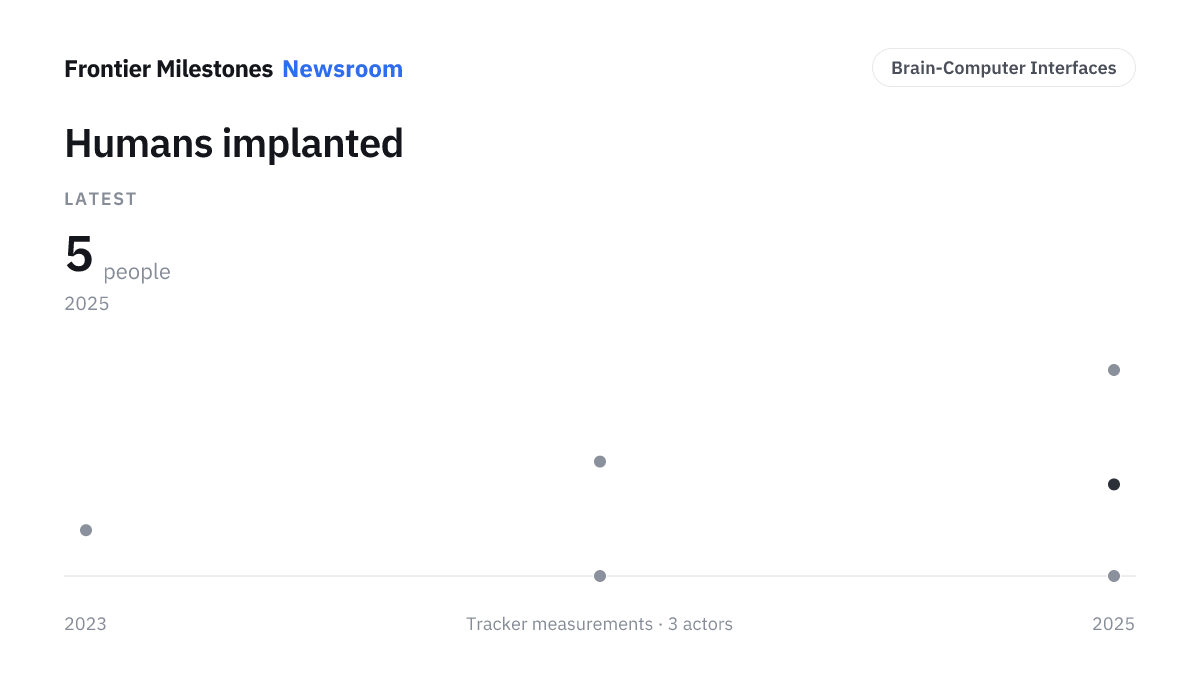
Roughly sixteen people carry a company's brain implant. In 2026 the field crossed from trials into products: China approved and implanted the first commercial invasive BCI, and Europe cleared the first BCI to restore reading vision — both ahead of Neuralink.
Paradromics — Connexus / Convey, Connect-One early feasibility study — The FDA cleared Paradromics to widen its Connect-One early feasibility study so participants with the Connexus implant can drive a broader range of ordinary personal devices — phones, tablets and computers — through the Convey interface, rather than only the lab-controlled setup the study started with. It is a study-protocol expansion, not a marketing approval: Connexus remains investigational, and the number of implanted participants is still small. The significance is what an implant is being allowed to control, moving from cursor-and-keyboard demonstrations toward the devices patients actually use.
University of Michigan neurosurgeons completed the first-in-human implantation of Paradromics' Connexus BCI — 421 microelectrodes with a wireless chest transceiver — in a woman with motor neuron disease, opening the Connect-One long-term feasibility trial.

 Neuralink
 Synchron