UBTECH — Liuzhou, Guangxi, China — UBTECH began production on 12 Sep 2026 at a 14,000 m² plant in Liuzhou designed for more than 10,000 humanoid robots a year — the first facility at that scale anywhere — building Walker S and Cruzr series industrial units, with Siemens Digital Industries Software as the manufacturing-software partner. The number that makes this different from the month's other production announcements is the stated line rate: one robot off the line every 10 minutes. That is still a design figure rather than reported output, and annualising it depends on shift patterns nobody has published. But it is the first humanoid production claim in this run to carry a rate at all.
XPeng — IRON, Guangzhou — XPeng switched on what it calls the world's first automated production line for advanced humanoid robots, with more than 80% of core processes automated, and an IRON unit walked off the line under its own power on 8 Sep 2026. Read the sequence carefully: this is the line starting, not mass production. XPeng's own timetable still puts mass production at the end of 2026, first deployments into its own stores and industrial parks — reception, vehicle demos, guidance, inspection, small-item handling — and commercial sales and deliveries in China and abroad in 2027. Several outlets reported this as XPeng beginning mass production and beating Tesla; the company said something narrower.
AgiBot shipped 5,168 humanoids in 2025 against roughly 150 each for Tesla, Figure and Agility — a 30× gap. Meanwhile Unitree became the first humanoid maker to list publicly and factories are being built for volumes nobody has yet sold. A read of shipments against ambition.
AgiBot / Minth Group / Serbia — Šabac — Mass production began on 29 Aug 2026 at Šabac, Serbia, in a joint project between China's AgiBot and auto-parts maker Minth Group — the first plant in Europe building Chinese-designed humanoids at scale. The first phase is put at about €20M and runs inside Minth's existing Majur metal-parts facility; the stated capacity target is 20,000 humanoids and robot dogs a year for European and global markets. The target is a plan, not an output figure: no unit count has been published, and the line is a converted parts plant rather than a purpose-built one.
Unitree Robotics — Shanghai STAR Market (688836) — Unitree began trading on Shanghai's STAR Market on 19 Aug 2026, the first humanoid-robot maker to reach a public market anywhere. The stock rose as much as ~630% intraday and closed the debut up ~460% at 845 yuan, valuing the company near $50B — an order of magnitude above the ~$7B private mark set months earlier. Unitree's revenue still comes mostly from quadrupeds and components rather than humanoids, and the shares gave back a large part of the debut gain in the following days; the milestone is the listing itself, not the price.
Tesla — Fremont, California — Optimus entered production at Fremont in late July/August 2026, in the floor space vacated by the Model S and Model X lines — Tesla tore those down in about 46 days after the last cars were built in early May. Musk had committed to the timing on the Q1 2026 earnings call and afterwards described the ramp as painfully slow, calling this year's rate "literally impossible to predict" given roughly 10,000 unique parts on an entirely new line. Treat the start, not the scale, as the fact here: Tesla has never published an Optimus production count, no per-unit figure has been disclosed for Fremont, and outside estimates of about 1,000–1,200 units across Fremont and Giga Texas are unconfirmed by the company.
NEURA Robotics — Germany's NEURA announced a Series C of up to $1.4B at a $7B valuation (Nvidia, Amazon, Qualcomm, Tether, Bosch, EIB…) — billed as the largest-ever raise for a full-stack robotics company; the full amount is milestone-contingent. 4NE-1 humanoid (~€98k) ships at scale from late 2026.
1X — 1X began full-scale NEO production at a 58,000 sq-ft, vertically-integrated plant in Hayward, California — ~10,000 units/yr capacity (its first-year run sold out in 5 days), targeting 100,000 units by 2027.
Figure AI — Figure ran its humanoids 200 hours nonstop, sorting 249,558 packages with zero hardware failures and no teleoperation — driven end-to-end by its Helix neural network, a durability/autonomy milestone.
A $39B valuation for Figure and billions across the field price in success that hardware and autonomy haven't yet delivered. Our read on whether capital is ahead of capability. (Our opinion, not investment advice.)
Our read — labelled opinion, not investment advice.
“Deployed at BMW/Amazon/Mercedes” usually means a supervised pilot, not autonomous production work. We explain the ladder from demo to paid pilot to true at-scale deployment.
Not every robot arm is a humanoid. The bet is on a general-purpose, roughly human-shaped, two-legged machine that can slot into spaces and tools built for people — versus cheaper, task-specific automation.
Apptronik — A $520M Series A extension (backers include Google, Mercedes-Benz and the Qatar Investment Authority) values Apptronik at $5B and lifts total funding to ~$1B, to scale Apollo production toward ~$80k/unit at volume from 2027.
Agility Robotics / Toyota — Toyota Motor Manufacturing Canada contracted seven Agility Digit humanoids (starting with three) for its Woodstock RAV4 plant under a robots-as-a-service deal (~$30/hr per robot) — a pilot-to-commercial step in auto manufacturing.
Boston Dynamics — Boston Dynamics retired its decade-old hydraulic Atlas and revealed a fully electric Atlas with super-human range of motion (360° hip, waist and neck rotation) — its pivot from research robot to industrial humanoid, with pilots beginning at Hyundai.
Hyundai Motor Group — Hyundai Motor Group completed its acquisition of a controlling 80% stake in Boston Dynamics from SoftBank (valuing it at $1.1B) — bringing the Atlas humanoid maker in-house and positioning the group as a humanoid frontrunner.
 UBTECH Robotics
  XPeng
XPeng 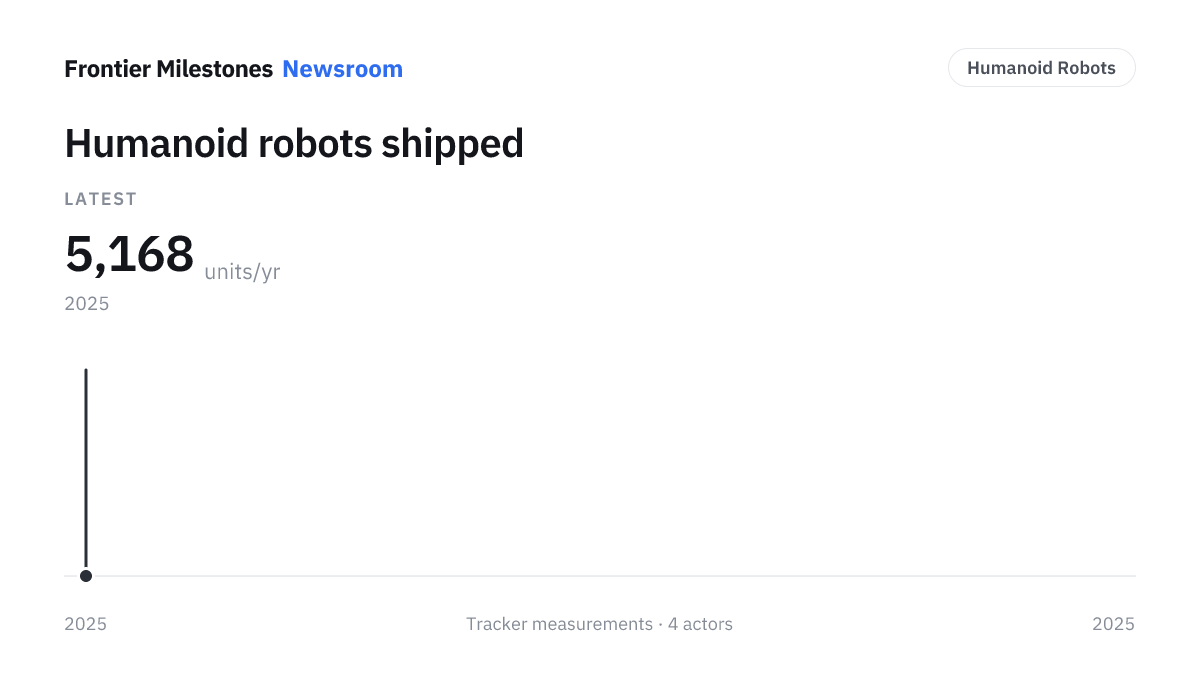
 AgiBot (Zhiyuan)
  Unitree
  Figure AI
  Tesla
Tesla  NEURA Robotics
  1X Technologies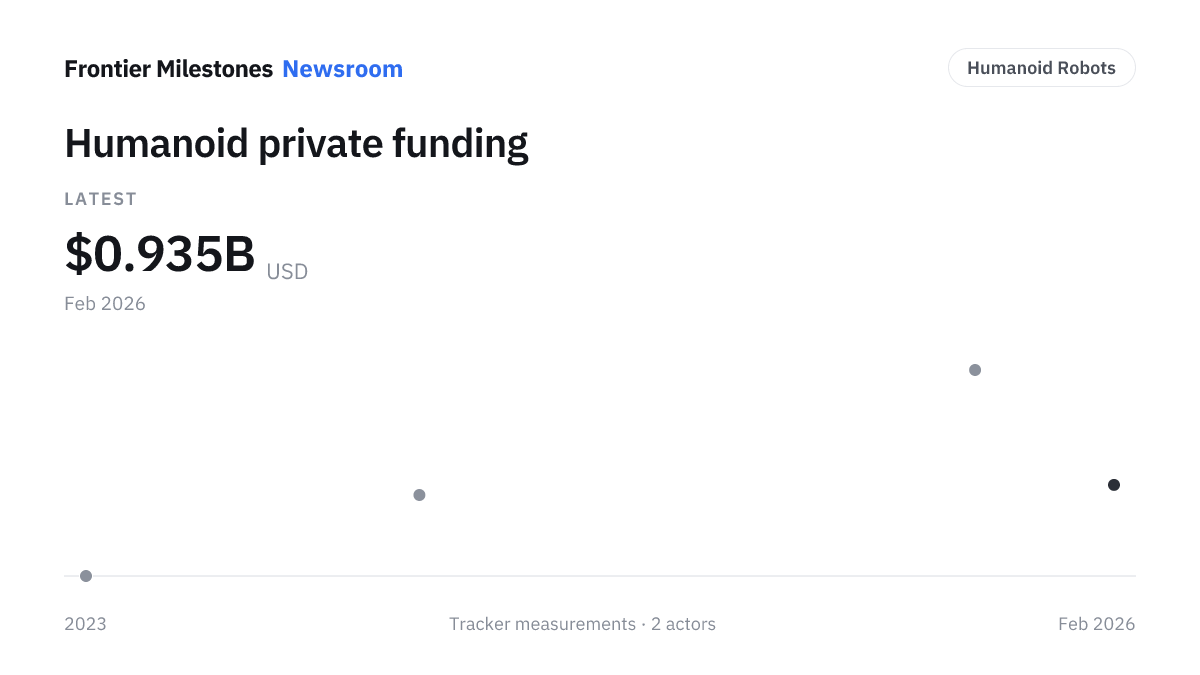
 Apptronik
  Agility Robotics
  Boston Dynamics
  Hyundai Motor Group