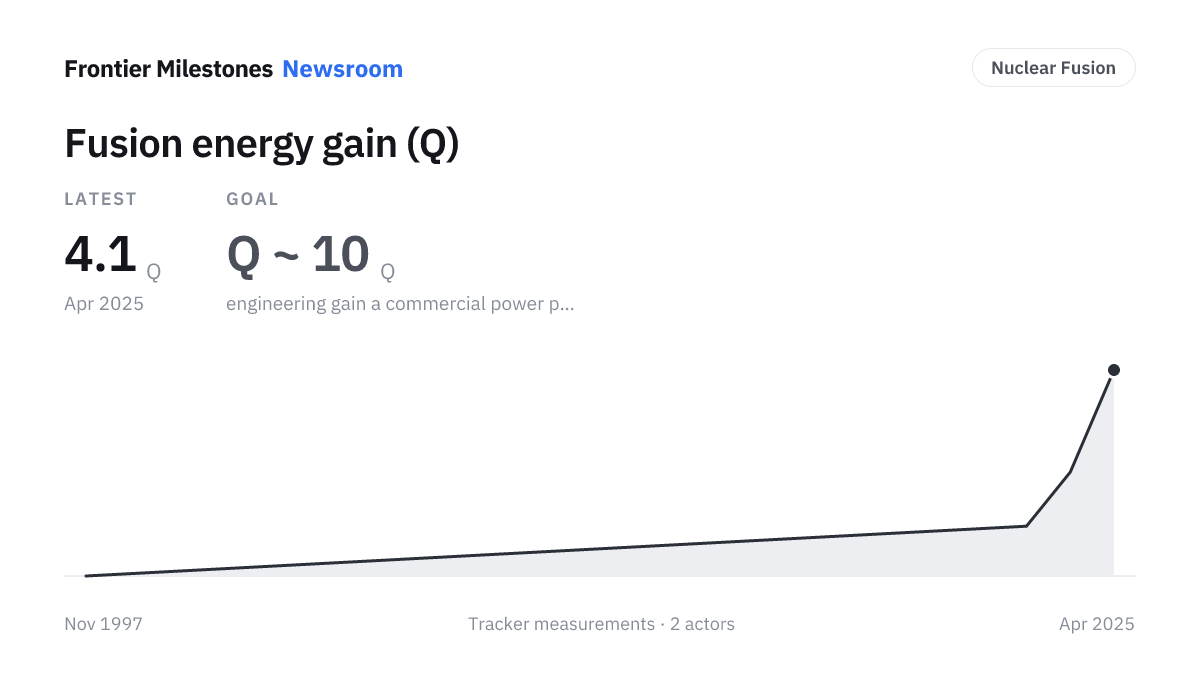
Records now fall on separate axes — gain 4.1 at NIF, 1,337 s at WEST, 150M°C at Helion — while the fairest physics yardstick, the triple product, still belongs to a 1996 experiment. A read of every fusion number this tracker holds, and what each one does and does not prove.
Tennessee / Type One Energy — Bull Run, Clinton, TN — Tennessee issued the first licence anywhere for a commercial fusion machine on 31 Aug 2026, presented by Governor Bill Lee at the Organization of Agreement States meeting in Nashville. It covers Project Infinity, Type One Energy's 400 MW stellarator plant at TVA's Bull Run Energy Complex in Clinton, and follows the state's first-in-the-nation fusion regulatory framework — built after the NRC delegated fusion regulation to the states. Type One plans to break ground on phase one this year and expects full startup by 2034. A licence is permission to build, not a machine that works: no stellarator has yet produced net energy, and the plant is a decade out.
Pacific Fusion — Mesa del Sol, Albuquerque, New Mexico — Pacific Fusion broke ground on 25 Aug 2026 on a ~$1B campus at Mesa del Sol in Albuquerque, to house its Demonstration System — a pulsed-magnetic (pulser-driven inertial) machine the company aims to bring to net facility gain, more fusion energy out than the whole facility draws in, by 2030. On the same day NNSA signed a memorandum of understanding with the company covering high-yield fusion work. The site is projected to add about 200 jobs. Ground breaking is a construction start, not a physics result: no Pacific Fusion machine has yet produced fusion energy.
General Fusion — General Fusion completed its business combination with Spring Valley Acquisition Corp. III and began trading on Nasdaq as GFUZ (10 Jul 2026) — the first publicly traded pure-play fusion company. The de-SPAC (~$1B pro forma) was backed by a ~$107.5M PIPE plus trust proceeds.
Helion Energy / Washington DOH — Helion secured the licenses to build and operate its Orion plant in Malaga, WA — a Radioactive Materials License and a Radioactive Air Emissions License from the Washington Department of Health — the first US (and world) fusion firm to clear full plant licensing. Under the NRC's decision to regulate fusion like particle accelerators rather than fission reactors, the state DOH is the licensing body. Electricity to Microsoft is targeted by 2028.
Xcimer Energy — Phoenix, a prototype for industrial-scale laser fusion, begins operations — demonstrating end-to-end KrF excimer amplification plus Stimulated Brillouin Scattering (SBS) pulse compression at >1 kJ through a 38 m gas optic (record energy and scale for SBS). First step toward the Vulcan laser and the Athena power plant; the gas-laser path targets lower cost than solid-state drivers.
Xcimer / US DOE — The DOE accepted Xcimer's 724-page preconceptual design and technology roadmap for Athena, its laser-fusion power-plant architecture — billed as the industry's most comprehensive government review of a privately-developed fusion plant, under the DOE Fusion Milestone Development Program.
Germany / EU — Germany joins the EU 'Innovative Core Technologies' IPCEI, focused exclusively on fusion (not fission) — roughly €2.4B this legislative period, part of >€2B pledged for fusion R&D and pilots through 2029. National projects start 2027; the government's stated aim is to host the world's first fusion power plant.
Helion Energy — Thrive Capital-led $465M Series G nearly triples Helion's valuation to $15.5B and brings total raised to ~$1.5B, funding manufacturing scale-up toward its 2028 power deal with Microsoft.
Commonwealth Fusion Systems — CFS published five peer-reviewed papers (58 authors, a Journal of Plasma Physics special issue) laying the physics basis for ARC — its first commercial plant, designed to deliver 400 MW net to the grid in the early 2030s — building on lessons from SPARC.
Avalanche Energy — Avalanche's compact Orbitron device "Jyn" measured apparent ion temperatures above 1 keV (~11M°C, hotter than the Sun's core) — the community's take-notice threshold, hit in a desktop-sized machine.
Pacific Fusion — Pacific Fusion's pulser-module prototype (9 stages, 90 bricks) delivered 440 GW in an 80 ns burst — the highest-power single-step pulsed-power driver ever demonstrated — validating its trigger sync and unlocking a tranche of its >$1B Series A; demo-facility construction starts this summer.
General Fusion — General Fusion's LM26 magnetized-target machine mechanically compressed a magnetized plasma with a lithium liner, tripling electron temperature to ~8.4M°C (0.72 keV) — its first compressional-heating result, a concrete step on the in-progress path to a practical MTF demonstration (1 keV target next). Company-measured; results submitted for peer review.
ASIPP / CAS (CRAFT, Hefei) — China's ASIPP completed the world's largest toroidal-field (TF) superconducting magnet for a fusion device at the CRAFT facility — ~582 t, roughly 1.3× the volume and ~3× the stored energy of ITER's TF magnets, with full-parameter high-load testing and 100% domestic production. A size/engineering record — distinct from the institute's separate 35.1 T HTS field-strength record (Sep 2025).
ITER / General Atomics — The 13-tesla, ~1,000-tonne Central Solenoid — the 'beating heart' built by General Atomics to drive ITER's plasma current — is complete and delivered to the site. A key assembly milestone toward first plasma (2034); the full pulsed-magnet system was ~15 years in the making.
Focused Energy — German laser-fusion firm Focused Energy closed an oversubscribed $240M Series A led by utility RWE — the industry's largest Series A — to build its Lighthouse demonstrator at a retired German fission plant (total funding ~$500M incl. grants).
Zap Energy — Adds near-term ~50 MW modular fission reactors alongside its sheared-flow Z-pinch fusion, betting on shared materials, liquid-metal and power-conversion tech. Century platform hit a record 1.6 GPa plasma pressure and FuZE-A came online. Zabrina Johal (ex-General Atomics, US Navy nuclear) named CEO; cofounder Benj Conway → President.
Tokamak Energy / UKIFS — Tokamak Energy named Magnet Systems Partner for the UK government's STEP programme — the first-of-a-kind plant at West Burton (UKAEA / UK Industrial Fusion Solutions). A £70M (~$95M) contract (2026–2029) leading eight HTS magnet work packages via its TE Magnetics division; its ST40 spherical tokamak serves as a high-field testbed.
ARPA-E (US DOE) — ARPA-E committed $135M to fusion over 18 months — more than its entire prior 12 years of fusion funding combined — launching CHADWICK (first-wall materials for a 40-year plant life) and GAMOW (market-aligned fusion) programs.
First Light Fusion — First Light closed a £25m first tranche (Starmaker One + UKAEA) and shipped its first VIPER III velocity amplifiers to Texas A&M — a pivot to selling its amplification tech while pursuing its FLARE inertial-fusion concept (target gain ~1,000).
Cumulative private funding has crossed ~$9.8B across 53 companies (FIA 2025). We look at what the money is — and isn't — telling investors about timelines. (Our opinion, not investment advice.)
Our read — labelled opinion, not investment advice.
Records are falling fast — gain 4 at NIF, 1,000 s-plus plasmas in China and France — but engineering breakeven and a grid-connected plant are still distinct, harder steps. Our read on the gap. (Our opinion, not investment advice.)
Our read — labelled opinion, not investment advice.
NIF crushes a fuel pellet with lasers; EAST, JET and ITER hold plasma in magnetic fields. They post different numbers (gain vs duration) because they're different machines chasing the same goal.
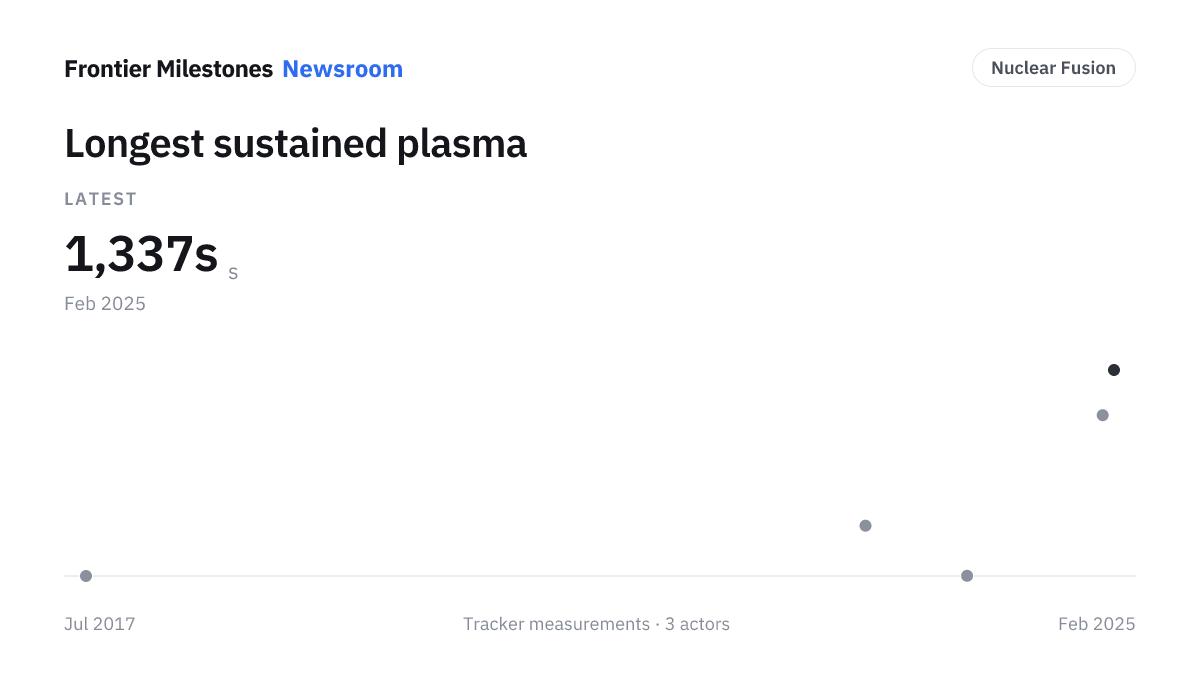
Hot enough to fuse, long enough to be a power source: EAST's 160M°C and WEST's 1,337 s tackle the two halves of the same problem. Neither alone makes a reactor.
NIF's climb to 8.6 MJ and target gain above 4 came less from more laser power than from better fuel capsules. We explain how high-density carbon (diamond) capsules and hohlraum quality turned a one-off ignition into a repeatable record.
Proxima Fusion / RWE / Bavaria / Max Planck IPP — Proxima Fusion, RWE, the Free State of Bavaria and Max Planck IPP signed an MOU to build Europe's first commercial stellarator fusion plant. It starts with 'Alpha', a €2B (~$2.3B) demonstration stellarator in Garching aiming to be the first stellarator to reach net energy gain (Q>1) in the 2030s; a commercial 'Stellaris' plant would follow at RWE's decommissioning Gundremmingen nuclear site. IPP leads physics, Proxima engineering, RWE plant construction.
DTT / ENEA — The first 1 MW, 170 GHz gyrotron (THALES TH1509) for Italy's DTT passed acceptance at the Swiss Plasma Centre — 1 MW for 100 s, the first European demonstration of an industrial MW-class 170 GHz tube. A key step for DTT's ECRH heating; 15 more units to follow.
NIF passed scientific breakeven in 2022 — but the lasers drew ~300 MJ from the wall to deliver 2 MJ to the target. Engineering breakeven, where the whole plant nets energy, is the bar that matters for the grid.
Q is fusion energy out divided by energy in. Q=1 is scientific breakeven; a power plant needs Q well into the tens. We explain why NIF's “gain 4” and a plant's Q aren't the same number.
EAST (ASIPP) / CAS — EAST ran stable plasmas at 1.3–1.65× the Greenwald density limit (vs the usual 0.8–1.0) using ECRH-assisted ohmic start-up — clearing a decades-old barrier in magnetic confinement. Higher density lifts the fusion rate and the triple product toward breakeven. Published in Science Advances (Jan 2026); ASIPP, Huazhong University and Aix-Marseille.
ITER / Westinghouse — A $180M contract for Westinghouse to complete and weld ITER's vacuum vessel — the hermetic double-walled steel chamber that houses the plasma — joining its nine sectors into a single ring, the most intensive stage of ITER assembly.
WEST (CEA) — WEST (CEA, France) held a hydrogen plasma for 1,337 s — about 22 minutes — at 50M°C with a tungsten wall and 2 MW of heating, surpassing EAST's 1,066 s by ~25% for the longest sustained fusion plasma on record.
KSTAR / KFE — In its 2023–24 campaign, after a tungsten divertor upgrade, KSTAR sustained high-confinement (H-mode) plasma for 102 s and held ion temperatures of 100M°C for 48 s — both device records. The team's next goal is 300 s above 100M°C by the end of 2026.
 NIF / LLNL
  WEST (CEA)
  Type One Energy
  Pacific Fusion
  General Fusion
  Helion Energy
  Xcimer Energy
  Commonwealth Fusion Systems
  Avalanche Energy
  ITER
ITER  Focused Energy
  Zap Energy
  Tokamak Energy
  First Light Fusion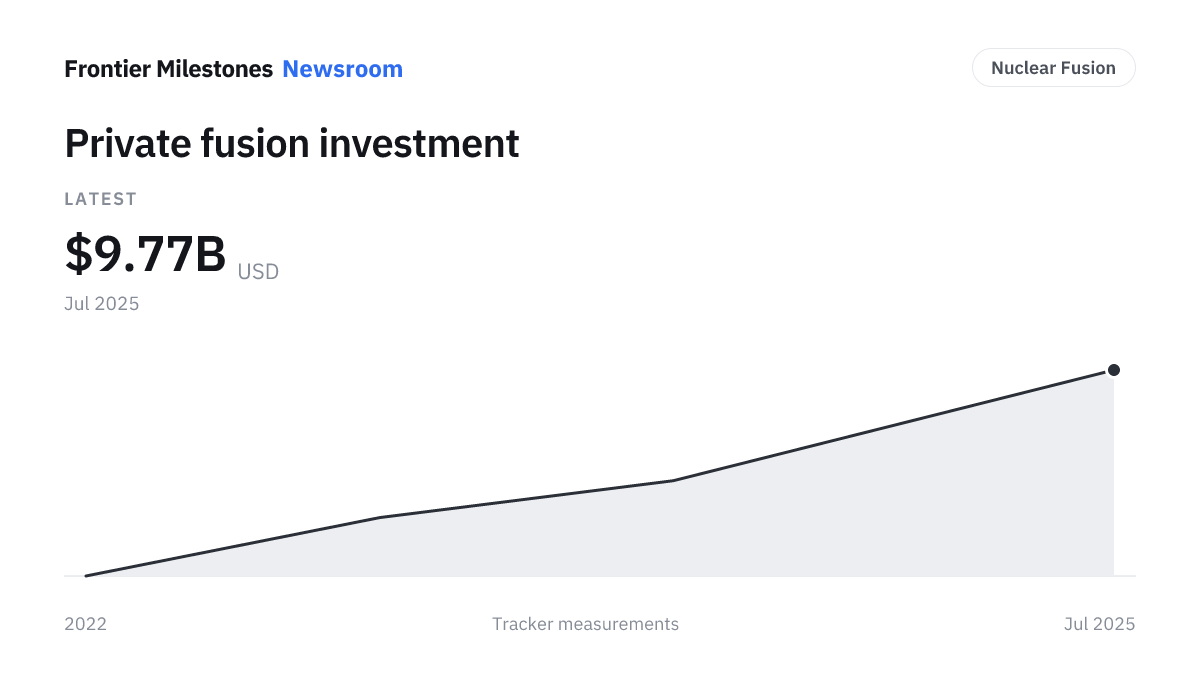
 Proxima Fusion
  DTT (ENEA)