US Department of Commerce — D-Wave, Rigetti, Quantinuum, PsiQuantum — D-Wave, Rigetti and Quantinuum each finalized $100M CHIPS and Science Act agreements with the Commerce Department on 8 Sep 2026, and PsiQuantum signed definitive documentation for $100M of its own. The condition attached to the first three is the notable part: the federal government takes a minority, non-controlling equity stake in each company. The stated work is manufacturing, not algorithms — D-Wave toward a 100,000-qubit annealer and a 10,000-qubit gate machine with 100 logical qubits; Rigetti on miniaturised readout electronics, a new cryostat architecture and high-connectivity fabrication; Quantinuum on 300 mm ion-trap wafers with GlobalFoundries and lasers with Monarch Quantum; PsiQuantum on optical switches, high-temperature single-photon detectors and packaging.
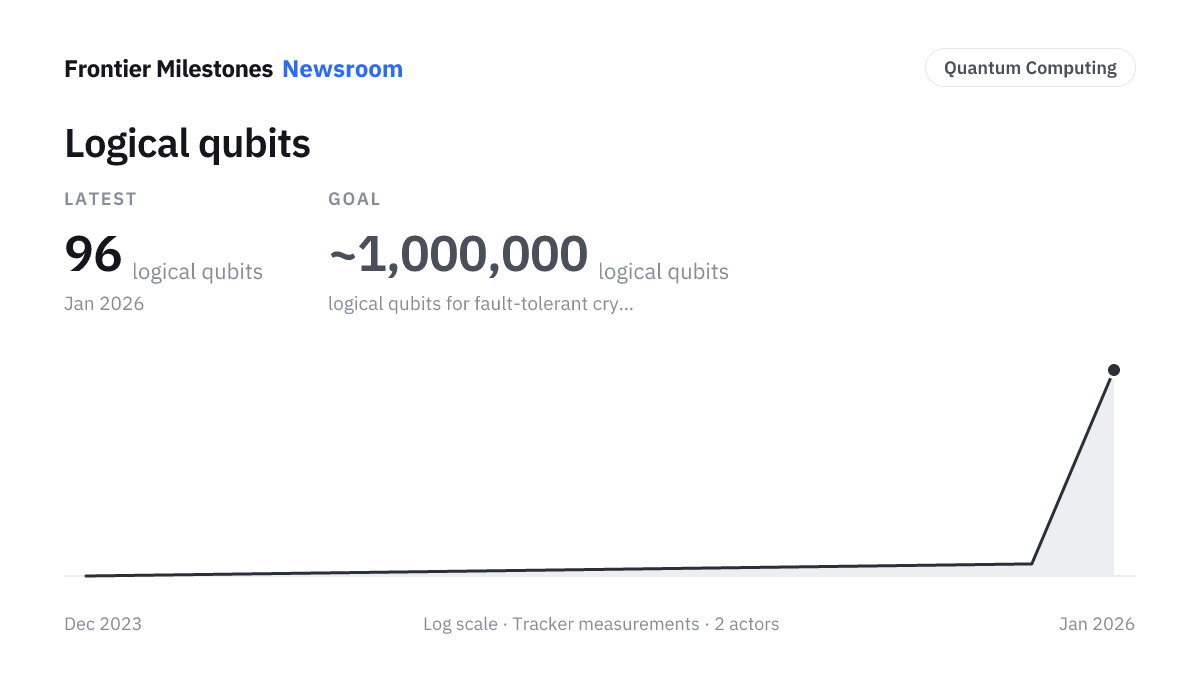
Error correction stopped being a promise in 2026 — 96 logical qubits, an 800× logical-to-physical gap, a 2:1 encoding ratio. The machine that breaks RSA still needs thousands of logical qubits. A read of every quantum number this tracker holds.
Honeywell / Defense Innovation Unit — MagNav — An Embraer 170 flew 4 hours 23 minutes over the Pacific — Puget Sound to southern Alaska and back — with GPS unavailable, navigating on Honeywell's MagNav quantum magnetometers. The system reads the Earth's crustal magnetic signature and matches it against a map, and DIU reports it improved position accuracy by 89% against the conventional backup methods flown alongside it. Navigation data streamed to the pilots on standard tablets, so fielding it needs no cockpit rebuild. MagNav began in spring 2024 as "Transition of Quantum Sensing"; 72 companies applied and Honeywell Aerospace was selected to build the prototype. A C-17 demonstration is planned later this year. This is quantum sensing, not quantum computing — the part of the field that is already flying.
IBM / HRL Laboratories (from Boeing and GM) — IBM completed its acquisition of HRL Laboratories on 26 Aug 2026, adding silicon-spin qubits to a roadmap built entirely on superconducting transmons, along with HRL's quantum sensing, cryogenics, control electronics and packaging work. Boeing and General Motors, HRL's former owners, stay on as partners. Terms were not disclosed. Silicon spin qubits are the modality that could ride existing semiconductor fabs, which is why IBM ties it to Anderon, its quantum wafer foundry — but this buys a research program, not a working machine: IBM's shipping systems remain superconducting.
Microsoft / Quantinuum — Peer-reviewed in Nature: error correction (carbon & tesseract codes) cut logical error rates up to 800x below the underlying physical qubits on Quantinuum trapped-ion hardware - the largest physical-to-logical gap yet independently validated, with repeated mid-circuit correction across up to 12 logical qubits.
Atom Computing — Atom Computing demonstrated sustained multi-round quantum error correction with a toric code on neutral atoms — logical error rates falling as the system scales up (sub-threshold), a first for the neutral-atom platform.
Quantinuum — Quantinuum priced an upsized IPO at $60/share, raising $1.68B on Nasdaq (QNT) at a ~$15.7B market value — the quantum industry's first mega-IPO. Honeywell retains ~48% voting power.
IQM / Oak Ridge National Laboratory — A 20-qubit IQM Radiance system ("Pathfinder") went live at Oak Ridge National Laboratory on 16 Jun 2026 — Finnish superconducting maker IQM's first US installation and the first commercially-procured quantum computer at the lab. It is co-located with Frontier, the world's most powerful open-science supercomputer, for HPC–quantum integration in the National Center for Computational Sciences test bed. The deployment comes ahead of IQM's planned Nasdaq listing via a business combination with Real Asset Acquisition Corp. (RAAQ).
Pasqal / CINECA (Italy) — Pasqal inaugurated SOL, a 140-qubit neutral-atom processor, at CINECA in Bologna — Italy's first neutral-atom quantum computer, engineered for tight integration with the Leonardo pre-exascale supercomputer (Top500 #10). Procured by the EuroHPC Joint Undertaking with Italy's research ministry, it is Pasqal's third EuroHPC-linked system after France and Germany — extending Europe's HPC–quantum integration push.
IonQ — IonQ launched Clavis XG Multiplex, letting quantum-key-distribution traffic run alongside classical data on existing metropolitan fiber — so operators need not redesign, isolate or dedicate optical networks for quantum security. Paired with its Clarion KX key-exchange platform, it targets the "harvest-now, decrypt-later" threat and aims to move customers from QKD pilots to production deployment.
Alice & Bob / GENCI (France) — France's HPC agency GENCI signed a public procurement (at VivaTech 2026) for an 18-cat-qubit Alice & Bob system — the world's first formal state acquisition of error-biased cat-qubit hardware, funded via France 2030's HQI (Hybrid HPC-Quantum) initiative. It will be installed at the CEA's TGCC center (Bruyères-le-Châtel) and hybridized with the Joliot-Curie supercomputer, accessible to researchers in 2027 — billed as the first early fault-tolerant QC (eFTQC) permanently sited in a European supercomputing center.
IBM / US Commerce — IBM is spinning off Anderon, a $2B (≈$1B CHIPS Act + $1B IBM) 300mm superconducting-qubit wafer fab in Albany, NY — open to other quantum vendors as a neutral 'TSMC for quantum.'
IonQ — IonQ sold its first 6th-gen, chip-based 256-qubit system (to the University of Cambridge) and posted record Q1 revenue of $64.7M (+755% YoY); its roadmap targets 10,000 networked qubits.
QuEra / Harvard / MIT — QuEra, Harvard and MIT showed qLDPC codes encoding 1,156 logical qubits into 2,304 physical (≈2:1, >50% rate), simulated into the "teraquop" regime (~1 error per trillion ops) — versus the hundreds-to-one ratio typical today.
Logical-qubit records are climbing fast, but breaking RSA-2048 needs thousands of logical (millions of physical) qubits with low error rates held for hours. Our read: real, but not imminent. (Our opinion, not investment advice.)
Our read — labelled opinion, not investment advice.
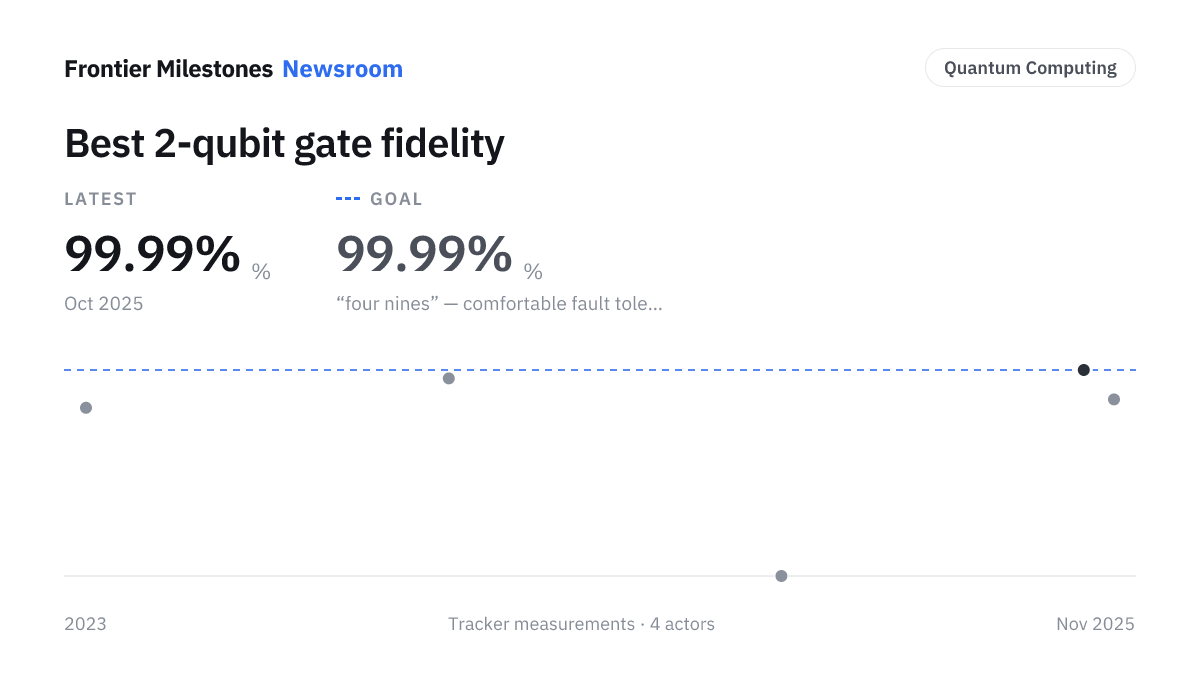
99.9% vs 99.99% looks like a rounding error but means 10× fewer mistakes. Error correction only pays off above a threshold near “three nines”; crossing “four nines” buys real headroom.
For decades, adding qubits added errors faster than you could correct them. “Below threshold” is the turning point where making the code bigger makes it more reliable — the precondition for a useful machine.
A 6,100-qubit array and 96 logical qubits sound contradictory until you know the difference. Physical qubits are the raw, noisy hardware; logical qubits are many physical ones error-corrected into one reliable unit. The second number is the one that matters.
Quantinuum — Quantinuum launched Helios: 98 trapped-ion (barium-137) physical qubits with 99.92% two-qubit-gate fidelity and all-to-all (QCCD) connectivity, running up to 48 error-corrected logical qubits — its most accurate commercial system.
Caltech — Caltech trapped 6,100 cesium atoms in optical tweezers — roughly 10× prior arrays — holding superposition ~13 s with 99.98% single-qubit accuracy and shuttling atoms without decohering, a key enabler for error correction. Published in Nature.
Rigetti Computing — Rigetti launched its 84-qubit Ankaa-3 superconducting system with a 99.5% median two-qubit gate fidelity — a major reliability jump from a redesigned qubit layout and Alternating-Bias Assisted Annealing, available on Rigetti's cloud and later AWS Braket / Azure.
 QuEra
QuEra  Quantinuum
  IonQ
IonQ  Honeywell
  IBM
IBM  Atom Computing
  IQM
IQM  Pasqal
  Alice & Bob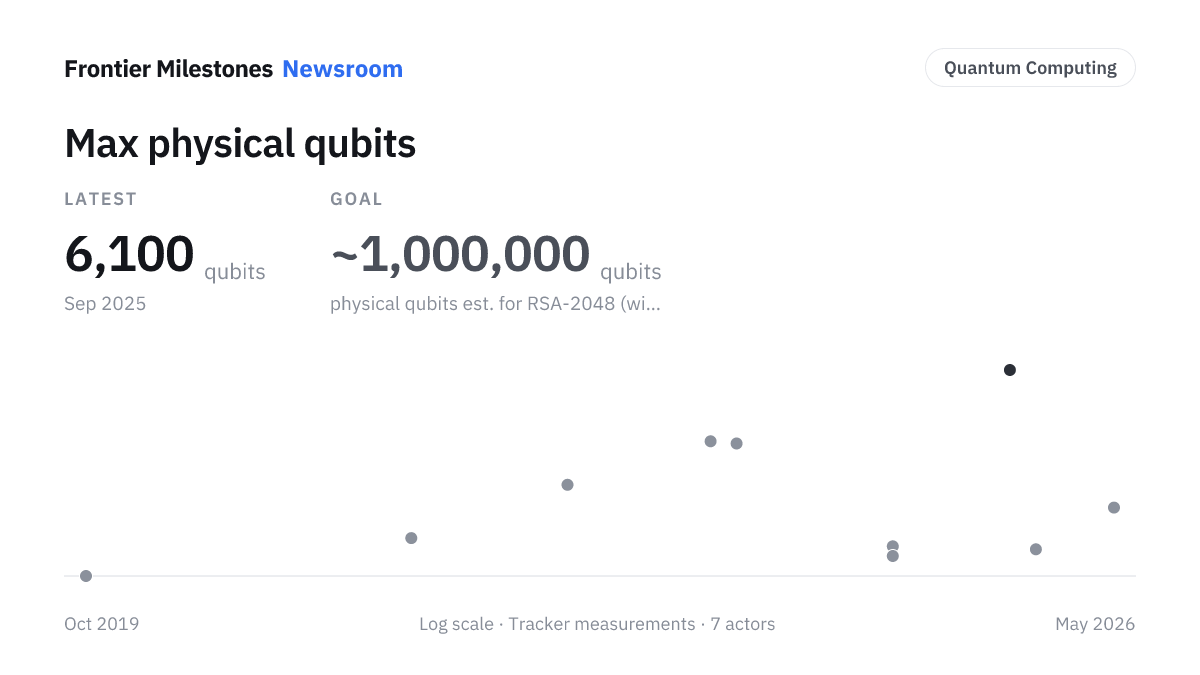
 Google Quantum AI
  Caltech
  Rigetti Computing