Nature Neuroscience — peer-reviewed, two participants — A study published in Nature Neuroscience on 14 Sep 2026 decoded speech and upper-body gesture simultaneously from one implant, driving a personalised avatar in real time. One participant, paralysed by a brainstem stroke, silently attempted five phrases alongside movements — waving, nodding, shaking hands, clapping. A second, with ALS, vocalised ten phrases while imagining ten gestures, holding still apart from facial muscles. The finding underneath is that simultaneous expression is not the sum of its parts: neural activity during combined speech-and-gesture differs from either alone, and decoders trained on simultaneous data outperformed ones trained on the isolated kind. Two participants, peer-reviewed — which is the bar this field has often skipped.
Paradromics — Connexus, Connect-One early feasibility study — The first participant implanted with Paradromics' Connexus BCI — a Michigan woman in her sixties with a progressive motor neuron disease — used it for unscripted, real-time speech and text. The distinction from earlier speech neuroprostheses is what she was doing: not copying researcher-selected phrases but choosing her own words, answering open questions, and talking to her grandchildren on a live phone call. Paradromics also reports separating neural signatures for attempted speech, where the person tries to produce sound, from imagined speech, where language is generated internally without any attempt — two different control signals from one implant. This is one participant in an FDA-IDE early feasibility study, and accuracy, vocabulary and durability figures have not been published.
Roughly sixteen people carry a company's brain implant. In 2026 the field crossed from trials into products: China approved and implanted the first commercial invasive BCI, and Europe cleared the first BCI to restore reading vision — both ahead of Neuralink.
Paradromics — Connexus / Convey, Connect-One early feasibility study — The FDA cleared Paradromics to widen its Connect-One early feasibility study so participants with the Connexus implant can drive a broader range of ordinary personal devices — phones, tablets and computers — through the Convey interface, rather than only the lab-controlled setup the study started with. It is a study-protocol expansion, not a marketing approval: Connexus remains investigational, and the number of implanted participants is still small. The significance is what an implant is being allowed to control, moving from cursor-and-keyboard demonstrations toward the devices patients actually use.
Science Corporation — Science began PRIMA's European commercial launch under a CE mark valid across 30 countries — the first BCI cleared anywhere for form-vision restoration. Its subretinal photovoltaic implant plus camera glasses restored functional central vision in geographic-atrophy (dry-AMD) patients; 80% read letters, numbers and words in the NEJM-published trial. First German procedures could come in September.
Neuracle (Shanghai) — Neuracle's NMPA-approved NEO implant was surgically placed in a paying patient at a Shanghai hospital — a man who lost hand function in a car crash a decade ago — the first time a commercially approved BCI has been implanted anywhere, four months after clearance and ahead of Neuralink.
A $9B valuation for Neuralink prices in a future where brain implants are routine — but today's devices help a few dozen people in trials. Our read on the gap between capital and clinical reality. (Our opinion, not investment advice.)
Our read — labelled opinion, not investment advice.
Demos and valuations are easy to inflate; people living with an implant are not. The count of humans implanted is the hardest signal that a BCI has crossed from lab to clinic — and Synchron, not the loudest name, leads it.
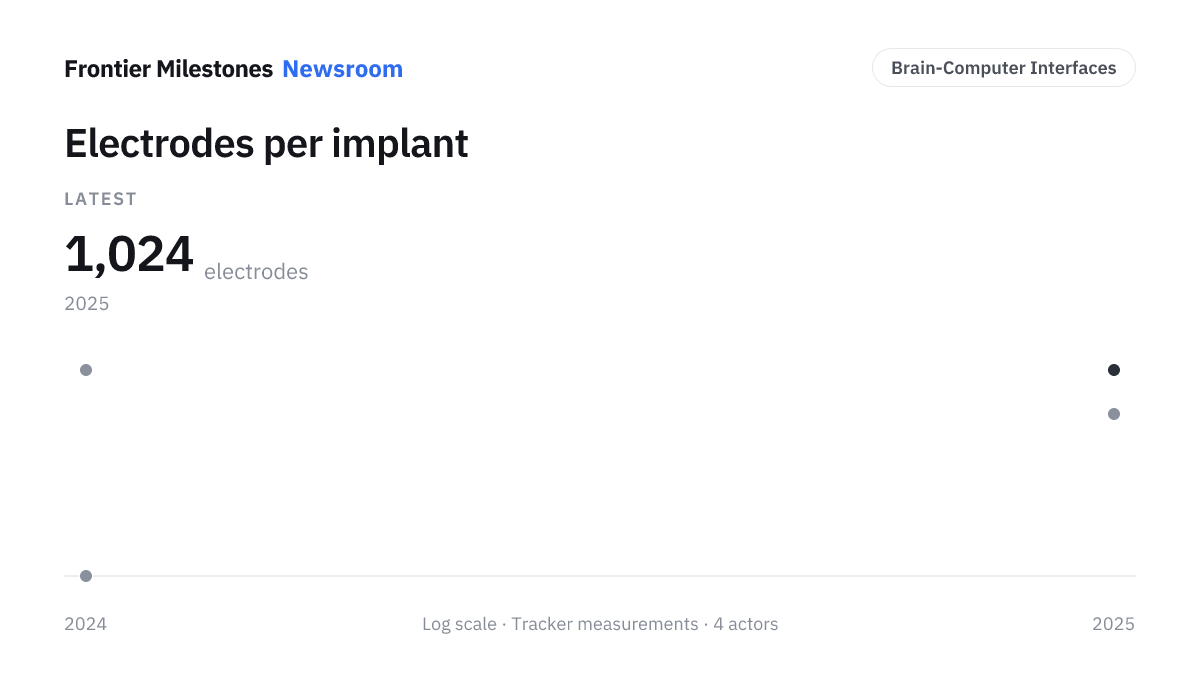
BCIs trade off signal quality against surgical risk. Penetrating arrays (Neuralink) read the most; surface arrays (Precision) sit on the brain; vascular devices (Synchron) avoid open-brain surgery entirely. The tracker compares all three.
CU Anschutz · Caltech · USC — Surgeons at CU Anschutz/UCHealth implanted a BCI into a paralyzed patient's higher-functioning cortex — not the usual motor cortex — a world first, aiming for more natural and complete sensory-and-motor control. Part of a Caltech/USC consortium using a Blackrock Neurotech array.
Science Corporation — Science closed an oversubscribed $230M Series C (total ~$490M) to commercialize PRIMA — a retinal BCI that restored form vision in dry-AMD patients (NEJM-published). A European launch later this year would make it the first BCI vision product on the market.
Neuracle / NMPA (China) — China's NMPA cleared Neuracle's coin-sized NEO implant (developed with Tsinghua) for commercial sale to restore hand function after spinal-cord injury — the first invasive-class BCI approved for market anywhere, ahead of Neuralink.
UC Davis / BrainGate2 — A BrainGate2 intracortical BCI at UC Davis decoded a man with ALS's attempted speech into on-screen words and synthesized voice in real time at up to ~97-99% accuracy from a large vocabulary (NEJM) — the first speech BCI accurate enough for natural conversation. It has since been used independently at home for thousands of hours, marking the shift from lab demo to daily communication.
 Paradromics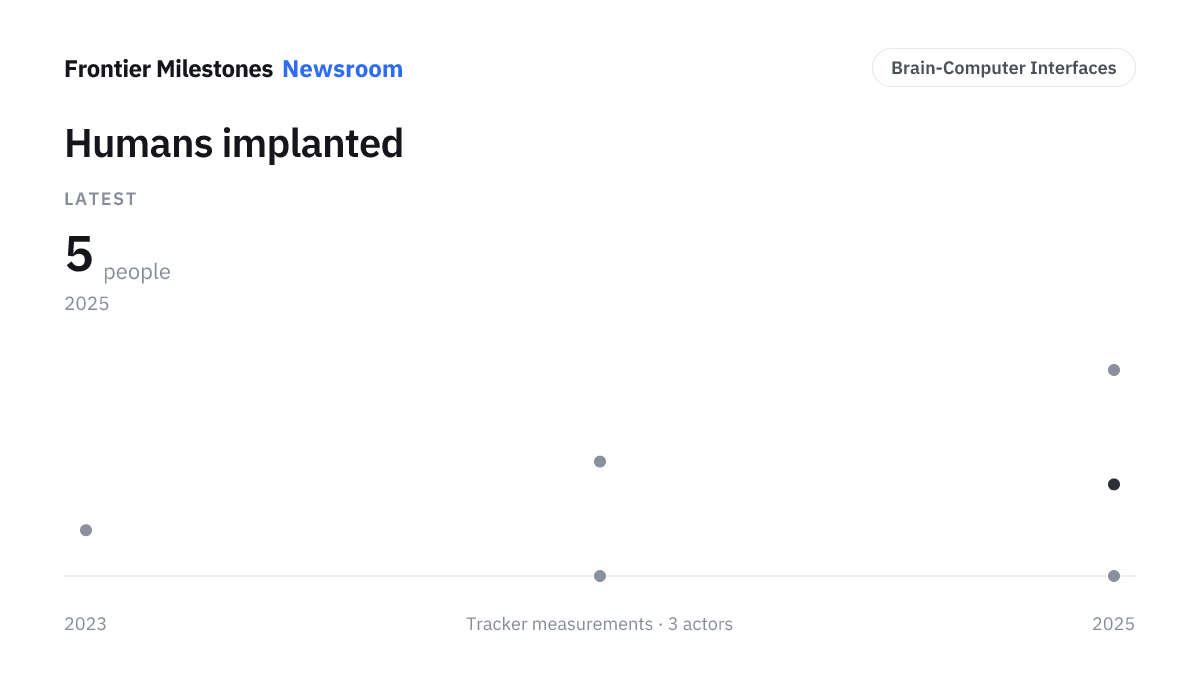
 Neuralink
  Synchron
  Science Corporation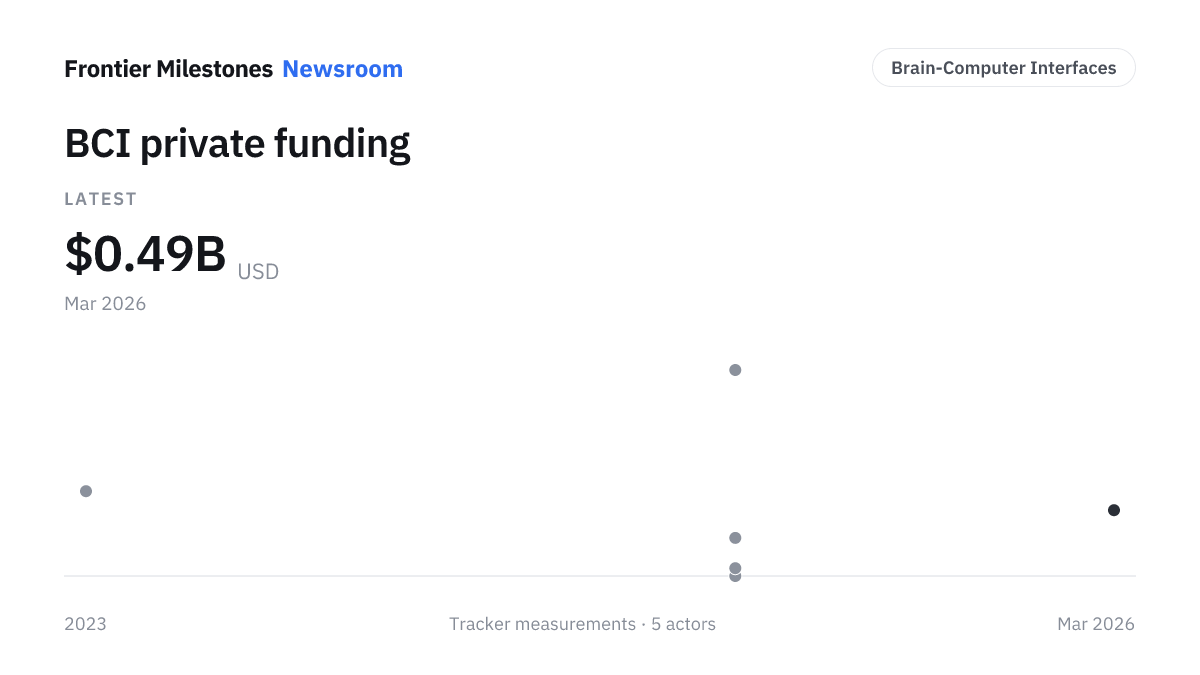
 Precision Neuroscience