Climeworks — Mammoth, Hellisheiði, Iceland — Climeworks reported that Mammoth removed 675 tonnes of CO₂ in the first half of 2026, close to six times the same period a year earlier, while the plant's operating cost fell by more than half. Upgraded sorbent and collector-container design more than doubled capture performance per container under real operating conditions, and the first upgraded containers are hitting their design figures. Hold the absolute number next to the nameplate: Mammoth was announced at 36,000 tonnes a year, so 675 tonnes in six months is roughly 4% of that rate. The improvement is real and independently meaningful for a sector that has struggled to run plants near spec; the gap between design capacity and delivered tonnes is the sector's actual problem. Climeworks did not disclose the cost per tonne.
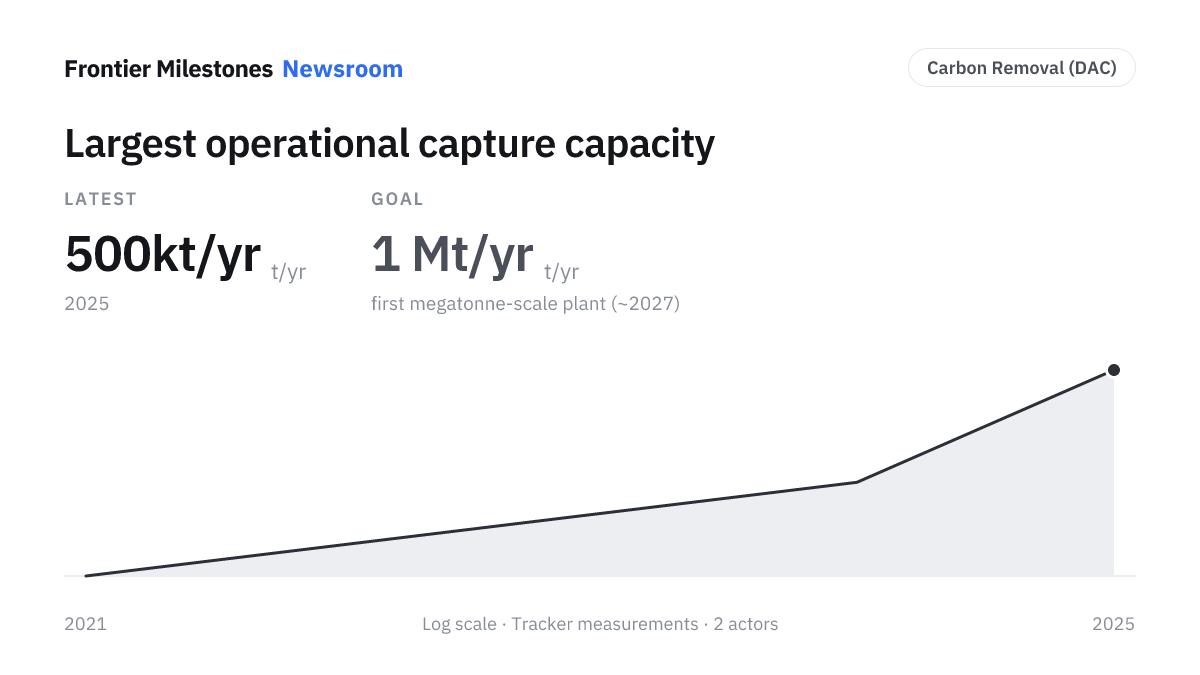
Capture capacity jumped from 4,000 t/yr in 2021 to 500,000 at Stratos in 2025 — a 125× scale-up in four years. Cost is the unsolved half: today's plants run $400–1,000 per tonne against a $100 target.
1PointFive / Occidental — 1PointFive's Stratos in Texas began ramping toward ~500,000 t/yr — over an order of magnitude larger than any prior plant, the first industrial-scale DAC facility.
Microsoft — Microsoft contracted multi-million tonnes of durable removal across suppliers — the demand that underwrites the buildout, making CDR a real market.
Savor — Savor made butter-like fat thermochemically from CO₂ and hydrogen, spotlighted by Bill Gates — a proof that captured carbon can become food, not just storage.
Climeworks — Climeworks' Orca in Iceland began operating at ~4,000 t/yr, pairing capture with permanent mineral storage — the first commercial direct-air-capture-and-storage plant.
 Climeworks
 Occidental (1PointFive)
 Heirloom
 Microsoft (Azure Quantum)