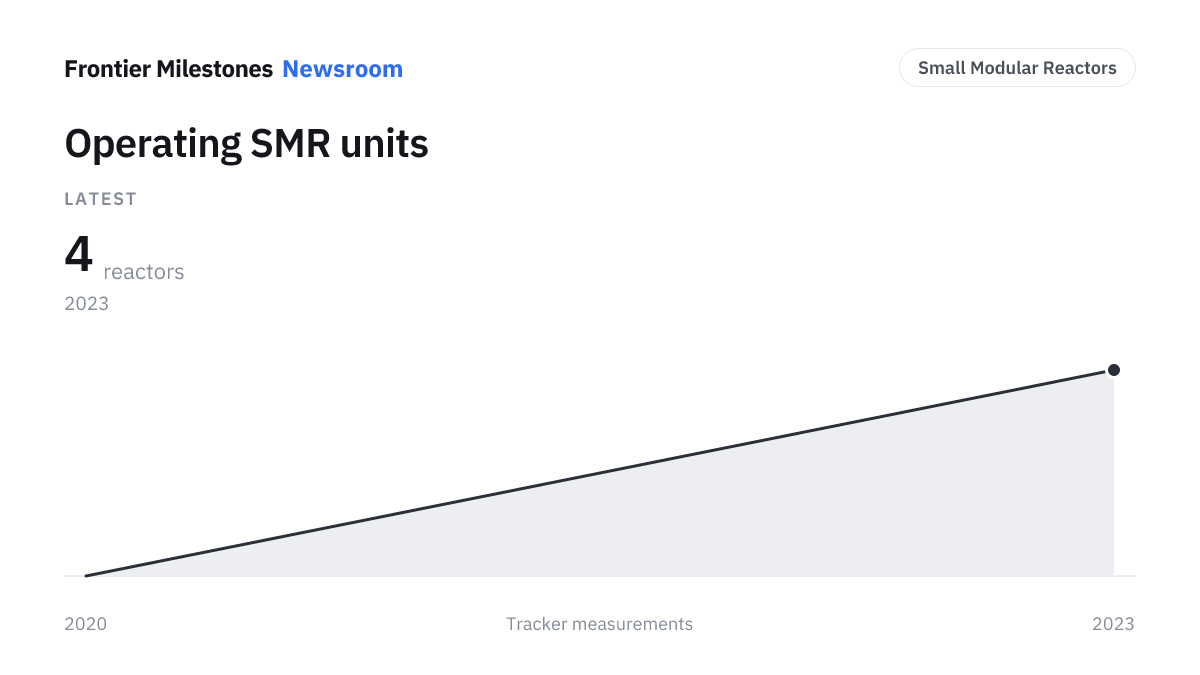
Four SMR units operate worldwide, all in Russia and China, and that count has not moved since 2023 — even as 2026 brought a construction permit, a modern licensing framework and four reactors reaching criticality in the US. A read of the gap between permits and power.
Westinghouse / NCERC (LANL, INL, NNSS) — Westinghouse's eVinci test article reached zero-power criticality at 10:39 a.m. PT on 24 Aug 2026 at the National Criticality Experiments Research Center in Nevada, with Los Alamos and Idaho National Laboratory. Zero-power criticality confirms the core's nuclear design — the reaction is self-sustaining — without generating usable heat or power, so it validates physics rather than demonstrating a working reactor. eVinci is a heat-pipe-cooled design with no pumps or coolant loops, sized at 5 MWe for remote sites and data centers; it was separately selected for the US Army's Janus Program at Fort Drum.
Oklo — Groves isotope test reactor, Lockhart, Texas — Oklo's Groves reactor reached first criticality at 9:19 p.m. ET on 5 Aug 2026 — a controlled, self-sustaining chain reaction less than a year after groundbreaking. It is the fifth reactor to go critical under DOE's Reactor Pilot Program and the first to do so on private land, built from scratch on a greenfield site rather than a federal laboratory campus. Groves is a low-power isotope test reactor, not a power plant: it establishes the operating base for commercial isotope production, while Oklo's Aurora power reactors remain a separate track.
Rosatom / Uzbekistan — First safety concrete was poured at the Jizzakh site near Lake Tuzkan — the first plant built anywhere under an export SMR contract. Rosatom is supplying two RITM-200N reactors (2×55 MWe) alongside two VVER-1000s for a 2.1 GW hybrid plant; first unit targeted for 2029.
Antares / Idaho National Lab — Antares' Mark 0 test reactor at Idaho National Laboratory achieved first criticality — a self-sustaining nuclear reaction and the first new US advanced-reactor design to cross the threshold (it is not yet generating power).
Oklo / US DOE — DOE's Idaho office approved the Preliminary Documented Safety Analysis (PDSA) for Oklo's Aurora-INL under the Reactor Pilot Program — a staged framework letting advanced reactors build on a federal site under DOE oversight instead of waiting on full NRC licensing. It clears the safety basis for construction (not commercial operation); Oklo pursues NRC licensing separately for commercial units.
TerraPower / UK ONR — TerraPower's Natrium design was accepted into the UK's Generic Design Assessment, with the Office for Nuclear Regulation, the Environment Agency and Natural Resources Wales beginning Step 1 in June 2026 — the sodium-cooled fast reactor's first overseas licensing push, following its US construction permit at Kemmerer. The same 345 MWe design with molten-salt storage boosting to 500 MW.
X-energy / US NRC — The NRC issued a Finding of No Significant Impact for X-energy's plan to build four 80 MWe Xe-100 reactors at Dow's Seadrift site on the Texas Gulf Coast — the first commercial nuclear project in the NRC's 52-year history cleared through a streamlined environmental assessment rather than a full environmental impact statement. The Amazon-backed developer still faces the separate safety review next.
Aalo Atomics / US DOE — US Energy Secretary Chris Wright signed authorization (25 Jun 2026, at Idaho National Laboratory) for Aalo Atomics to proceed with criticality testing of its Aalo-X critical test reactor under the DOE Reactor Pilot Program (EO 14301) — following DSA approval and an operational readiness review. The signed go-ahead is the milestone; criticality itself was expected within days (July 4 program target). Aalo-X tests the full core for the ~10 MWe Aalo-1 design.
OPG / GE Hitachi — OPG set the ~953-tonne basemat foundation module 35 m below ground for the first of four BWRX-300 units at Darlington — North America's (and the G7's) first SMR build, targeting grid connection by 2030.
Kairos Power — Kairos broke ground on Hermes 2 in Oak Ridge — the first power-producing Gen IV reactor with an NRC construction permit. The molten-salt-cooled plant will feed up to 50 MW to TVA, powering Google data centers.
Big tech power deals and listed names (NuScale, Oklo) have lifted SMR sentiment, but Western first-of-a-kind units don't reach the grid until ~2030. We weigh the gap between order books and operating reactors. (Our opinion, not investment advice.)
Our read — labelled opinion, not investment advice.
TerraPower / NRC — The NRC issued a construction permit for TerraPower's Natrium plant (Kemmerer, Wyoming) — the first US commercial advanced-reactor approval in ~a decade and the first non-light-water reactor approval in over 40 years. 345 MWe sodium-cooled fast reactor with molten-salt storage boosting to 500 MW; completion targeted 2030.
US NRC — After ~6 years, the NRC finalized Part 53 (effective 29 Apr 2026) — a risk-informed, technology-inclusive licensing framework targeting design approvals in 18 months or less at roughly half the cost. A structural unlock for the entire US advanced-reactor field, independent of any single project.
Headlines feature Western startups, but the only commercial SMRs operating today are Russia's floating Akademik Lomonosov (2020) and China's HTR-PM (2023). China's Linglong One aims to be the first land-based commercial unit in 2026.
SMRs are smaller (under ~300 MWe) reactors built in factories and shipped as units, betting that repetition and standardization beat the cost overruns of giant one-off plants.
Oklo / Idaho National Lab — Oklo broke ground (22 Sep 2025) on Aurora-INL — its first Aurora Powerhouse, a 75-MWe liquid-metal-cooled, metal-fueled fast reactor at Idaho National Laboratory (building on EBR-II heritage) under DOE's Reactor Pilot Program, with Kiewit as lead constructor.
 TerraPower
  Oklo
Oklo  NuScale Power
  Westinghouse
  X-energy
  Aalo Atomics
  GE Vernova Hitachi
  Kairos Power