Pony.ai / Verne / Uber — Zagreb, Croatia — Pony.ai and Verne began fully driverless robotaxi rides carrying passengers on public roads in Zagreb on 10 Sep 2026, the first time a European robotaxi programme has removed the human safety operator from the vehicle. The route runs 22 km linking Verne's headquarters and a central business district to Franjo Tuđman Airport, with the driverless area to be widened over the following months. These are test rides on top of the commercial service the three partners launched in Zagreb in April 2026, which carries safety operators — so Europe now has a supervised paid service and an unsupervised test programme, not a driverless commercial service. Pony.ai's overseas pipeline exceeds 4,000 robotaxis, including more than 2,000 planned with Uber across Europe.
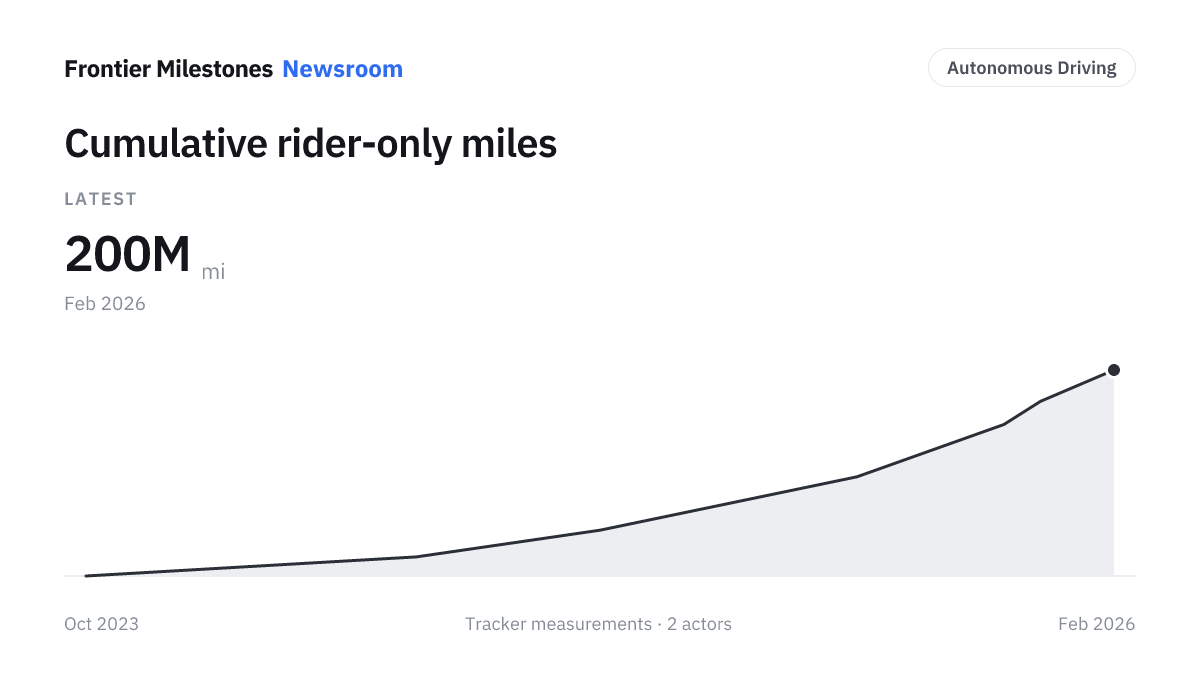
Waymo runs 450,000 paid driverless rides a week on 200 million rider-only miles, and 2026 brought the field's first paid rides with no steering wheel, a London licence — and its first real setbacks: a 3,791-vehicle recall, a freeway pause, and China's first nationwide permit freeze.
Wayve / Uber / Transport for London — Uber and Wayve began carrying paying passengers in London on 3 Sep 2026 in fewer than 20 Ford Mustang Mach-Es — Britain's first robotaxi service. It is supervised, and the licensing explains why: the cars were approved as private hire vehicles, not as automated vehicles, so a TfL-licensed driver sits at the wheel and remains legally responsible for the whole journey. Riders cannot request one; the Uber app may match them with a Wayve car, which they can accept or decline, at the normal fare. Removing the safety driver needs a separate approval under the UK pilot framework, with no published timeline.
Tesla — Cybercab, Austin, Texas — Tesla began charging fares for Cybercab rides in Austin on 3 Sep 2026 — the two-seater is built with no steering wheel, no pedals and no mirrors, making it the first purpose-built driverless vehicle to carry paying passengers at scale. There was no launch event: a small group of shareholders and friendly accounts rode first, then the Robotaxi app opened more widely. The same day, NHTSA opened Audit Query AQ26002 covering roughly 1,000 Cybercabs — the self-certified population, not the deployed fleet; about 45 were registered in Texas at launch — asking whether Tesla followed the proper process in self-certifying a car with no controls against crash standards written for conventional vehicles. An audit query is not a recall or a finding of danger — it is a question about the paperwork that made the deployment legal.
Waymo / California Public Utilities Commission — The CPUC cleared Waymo on 14 Aug 2026 to charge for fully driverless rides across 18 counties — 12 in the north (the whole Bay Area plus Sacramento, Santa Cruz, Sonoma and others) and six in the south (Los Angeles, Orange, Riverside, San Bernardino, San Diego, Ventura) — opening Sacramento and San Diego as new markets. The authority covers freeways, city streets, rural roads and rail crossings, day or night, in rain, fog and hail; only widespread snow or ice is excluded. It is permission, not deployment: Waymo says the rollout stays measured, so most of the approved territory has no service yet.
Zoox (Amazon) — Las Vegas — Zoox began charging fares in Las Vegas on 10 Aug 2026 — the first US operator to take money for rides in a purpose-built vehicle with no steering wheel, pedals or mirrors. It follows a temporary NHTSA exemption granted in July from federal rules requiring human controls, covering up to 2,500 vehicles a year for two years. Zoox had run free public rides in Las Vegas and San Francisco for about a year; fares combine a base charge with distance and time, quoted before booking.
Wayve / Uber / Transport for London — Transport for London granted private hire vehicle licences to a number of Wayve's autonomous Ford Mustang Mach-E cars in early August 2026, satisfying the "triple lock" — operator, driver and vehicle each licensed by the same authority — that London requires for paid trips. Rides remain supervised: a TfL-licensed driver sits at the wheel and can take over. Early trips for part of the 100,000+ interest list Uber built in eight weeks are due later this summer, before a public launch.
Pony.ai / ComfortDelGro (Singapore) — Pony.ai, with Singapore operator ComfortDelGro, opened driverless robotaxis to the general public in Punggol on 22 Jun 2026 — bookable by anyone via the Zig app. It is the Chinese operator's first fully public service outside China (April was invite-only) and a notable step in the global robotaxi race; Pony.ai targets 3,500+ robotaxis across 20+ cities by end-2026.
Waymo — Waymo suspended all freeway rides (San Francisco, LA, Phoenix, Miami) to improve construction-zone handling, after recalling 3,791 vehicles over flooded-roadway incidents — a notable safety pullback on its hardest driving domain.
China (MIIT) / Baidu — After 100+ Baidu Apollo Go robotaxis failed simultaneously in Wuhan (a cloud outage stranded riders up to two hours), China suspended all new autonomous-driving permits on 29 Apr 2026 — the first nationwide robotaxi licensing freeze.
Waymo leads on paid driverless rides and miles; Tesla is betting on a camera-only, mass-market path; Cruise exited in 2024. We weigh the very different strategies. (Our opinion, not investment advice.)
Our read — labelled opinion, not investment advice.
Cumulative rider-only miles are the experience base behind safety claims: more real, driverless miles means more rare situations seen and handled. It's the denominator under every crash-rate comparison.
“Self-driving” spans everything from lane-keeping (Level 2) to no-human-needed robotaxis (Level 4). Waymo runs Level 4 in set areas; most consumer “autopilot” is Level 2. The gap is the whole game.
Tesla — Tesla began public Austin robotaxi rides with no human safety monitor in the car (22 Jan 2026); by June it covered the entire Austin metro (~245 sq mi, ~13–20 Model Ys), though remote operators can still intervene.
 Pony.ai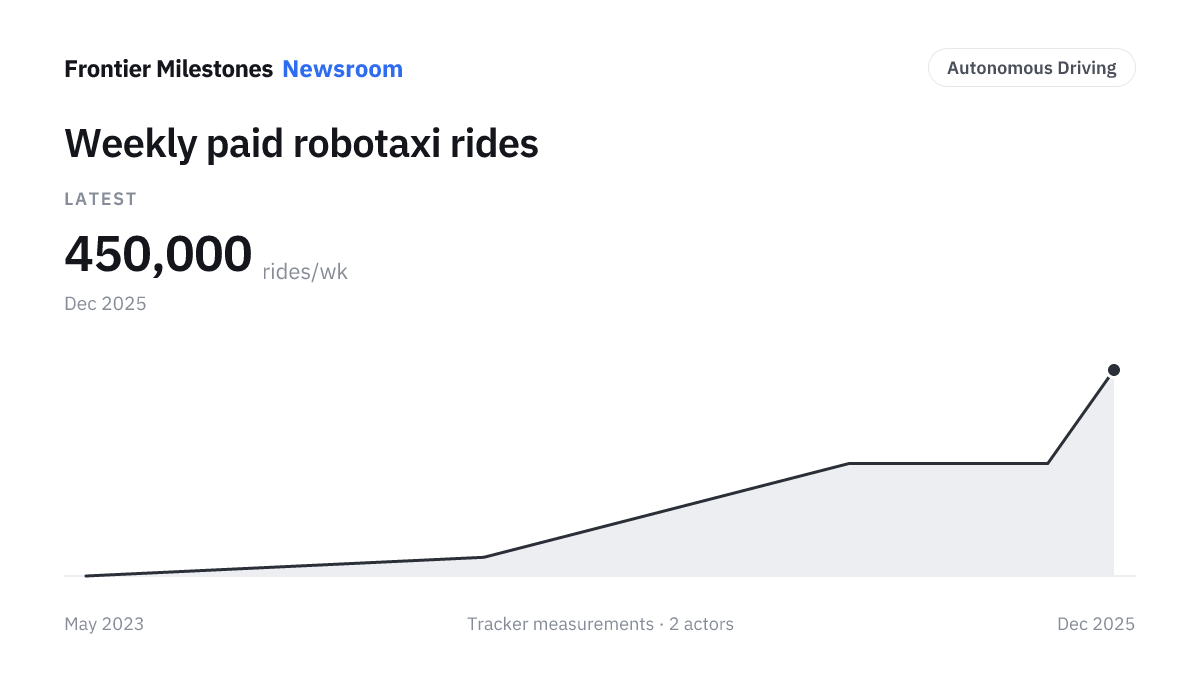
 Waymo
Waymo  Zoox
Zoox  Wayve
Wayve  Tesla
Tesla