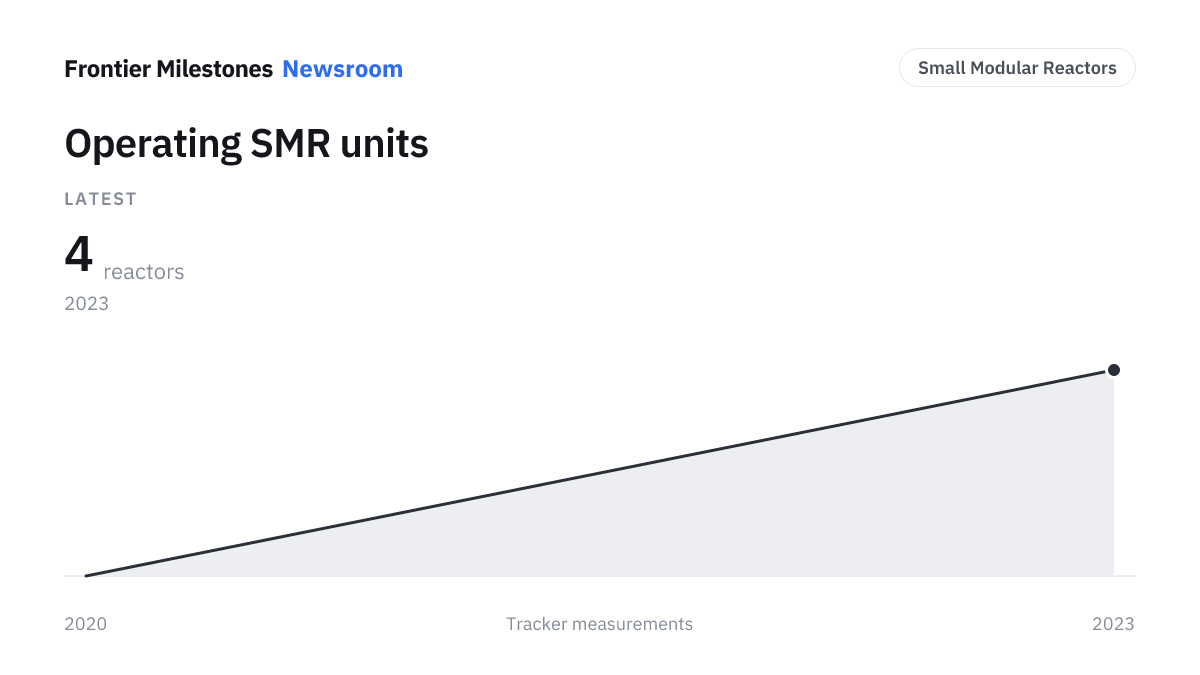
Four SMR units operate worldwide, all in Russia and China, and that count has not moved since 2023 — even as 2026 brought a construction permit, a modern licensing framework and four reactors reaching criticality in the US. A read of the gap between permits and power.
Oklo — Groves isotope test reactor, Lockhart, Texas — Oklo's Groves reactor reached first criticality at 9:19 p.m. ET on 5 Aug 2026 — a controlled, self-sustaining chain reaction less than a year after groundbreaking. It is the fifth reactor to go critical under DOE's Reactor Pilot Program and the first to do so on private land, built from scratch on a greenfield site rather than a federal laboratory campus. Groves is a low-power isotope test reactor, not a power plant: it establishes the operating base for commercial isotope production, while Oklo's Aurora power reactors remain a separate track.
The DOE granted Oklo startup authorization for its Groves Isotope Test Reactor, clearing the way to load fuel, run startup testing, and proceed toward first criticality — which Oklo targets this month. It's an early result of the federal Reactor Pilot Program's DOE-authorization pathway, which aims to fast-track advanced reactors outside national labs.
The NRC proposed a sweeping rule updating licensing, safety oversight and siting across a plant's whole lifecycle — risk-informed alternatives, performance-based emergency planning for all reactor types, longer license renewals. 45-day comment period.
Oklo acquired Creative Engineers (CEI), a chemical-process-engineering firm specializing in sodium and alkali-metal systems directly relevant to its sodium-cooled Aurora reactor — its second in-house acquisition this month after ARMEC.
Oklo acquired ARMEC, an Oak Ridge precision-manufacturing firm, to bring high-precision machining for its reactor and fuel programs in-house — a vertical-integration step (deal closed early June).
Oklo / US DOE — DOE's Idaho office approved the Preliminary Documented Safety Analysis (PDSA) for Oklo's Aurora-INL under the Reactor Pilot Program — a staged framework letting advanced reactors build on a federal site under DOE oversight instead of waiting on full NRC licensing. It clears the safety basis for construction (not commercial operation); Oklo pursues NRC licensing separately for commercial units.
Oklo / Idaho National Lab — Oklo broke ground (22 Sep 2025) on Aurora-INL — its first Aurora Powerhouse, a 75-MWe liquid-metal-cooled, metal-fueled fast reactor at Idaho National Laboratory (building on EBR-II heritage) under DOE's Reactor Pilot Program, with Kiewit as lead constructor.

 TerraPower
  NuScale Power