Honeywell-backed trapped-ion leader (Honeywell QS + Cambridge Quantum); Helios system. Went public on Nasdaq (QNT) in June 2026, raising $1.68B at a ~$15.7B market value — the quantum industry's first mega-IPO.
D-Wave, Rigetti and Quantinuum each finalized $100M CHIPS Act agreements with the Commerce Department on 8 September, with the federal government taking a minority, non-controlling equity stake as a condition. PsiQuantum signed for $100M separately. Every project is about manufacturing — traps, cryostats, detectors, packaging — not algorithms.
Error correction stopped being a promise in 2026 — 96 logical qubits, an 800× logical-to-physical gap, a 2:1 encoding ratio. The machine that breaks RSA still needs thousands of logical qubits. A read of every quantum number this tracker holds.
A multi-year partnership puts Quantinuum's Helios — a 98-qubit trapped-ion machine with 99.921% average two-qubit gate fidelity — in a US Oracle Cloud Infrastructure AI data center, accessible as an OCI service alongside its GPU and HPC fleet. Oracle plans a preview of the quantum service in the coming months.
Microsoft / Quantinuum — Peer-reviewed in Nature: error correction (carbon & tesseract codes) cut logical error rates up to 800x below the underlying physical qubits on Quantinuum trapped-ion hardware - the largest physical-to-logical gap yet independently validated, with repeated mid-circuit correction across up to 12 logical qubits.
Quantinuum — Quantinuum priced an upsized IPO at $60/share, raising $1.68B on Nasdaq (QNT) at a ~$15.7B market value — the quantum industry's first mega-IPO. Honeywell retains ~48% voting power.
Quantinuum — Quantinuum launched Helios: 98 trapped-ion (barium-137) physical qubits with 99.92% two-qubit-gate fidelity and all-to-all (QCCD) connectivity, running up to 48 error-corrected logical qubits — its most accurate commercial system.

 D-Wave Quantum
  Rigetti Computing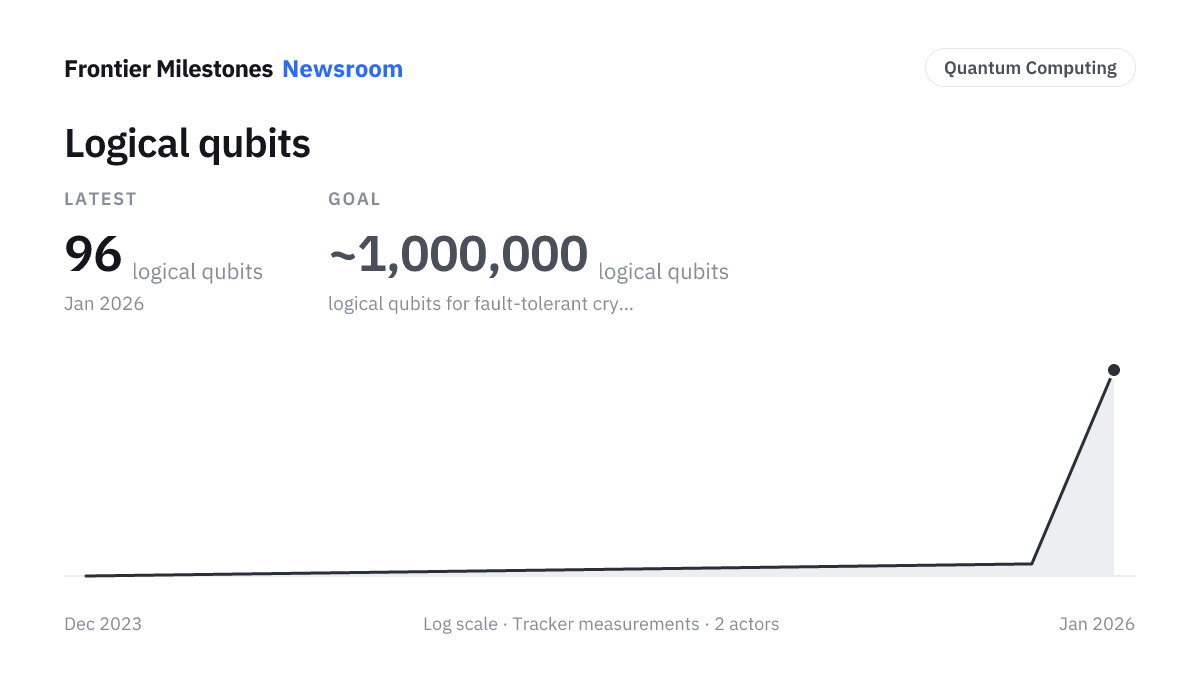
 QuEra
QuEra  IonQ
IonQ  Oracle