On October 7 DARPA advanced Atom Computing, Diraq, IBM and IonQ to Stage C, the final phase of its Quantum Benchmarking Initiative, where government evaluators physically test each company's hardware to judge whether it can reach utility scale by 2033. They join Microsoft and PsiQuantum. Neutral atoms, silicon spins, superconducting circuits, trapped ions, topological qubits and photonics will now be measured by the same outside party.
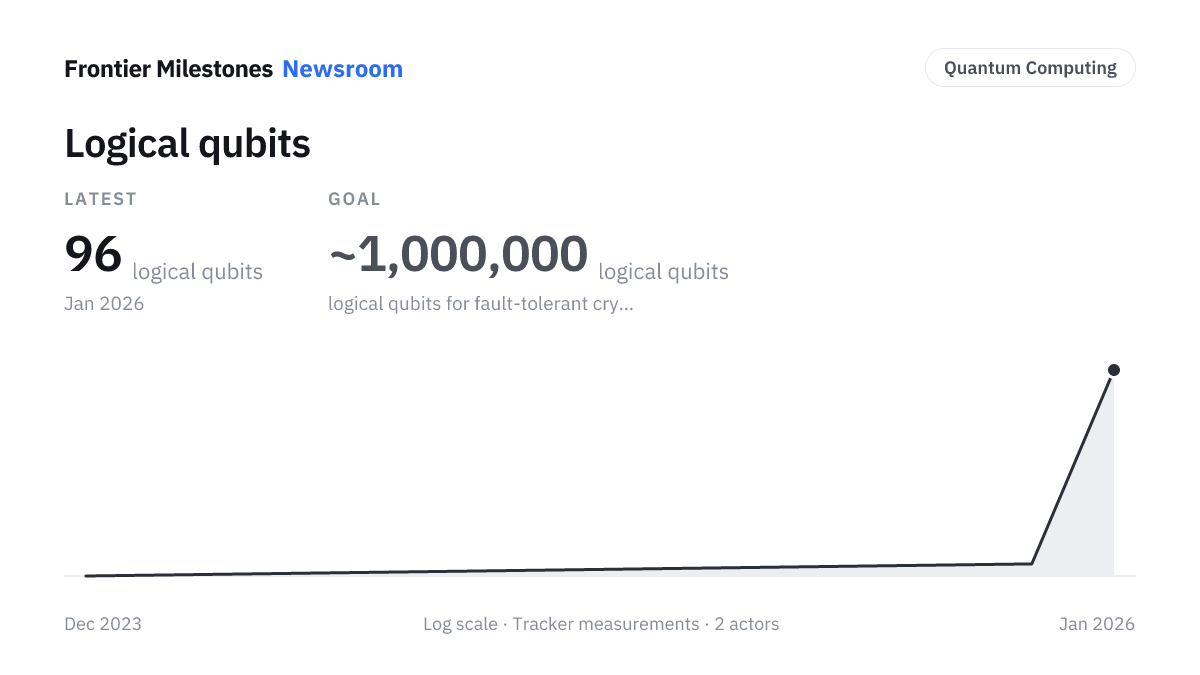
Error correction stopped being a promise in 2026 — 96 logical qubits, an 800× logical-to-physical gap, a 2:1 encoding ratio. The machine that breaks RSA still needs thousands of logical qubits. A read of every quantum number this tracker holds.
IonQ received final regulatory approval to acquire chip foundry SkyWater Technology ($35/share, cash-and-stock), closing July 31. It secures a fully domestic semiconductor supply chain — SkyWater's Minnesota, Florida and Texas fabs and advanced packaging — making IonQ, it says, the only vertically integrated full-stack quantum company.
IonQ — IonQ launched Clavis XG Multiplex, letting quantum-key-distribution traffic run alongside classical data on existing metropolitan fiber — so operators need not redesign, isolate or dedicate optical networks for quantum security. Paired with its Clarion KX key-exchange platform, it targets the "harvest-now, decrypt-later" threat and aims to move customers from QKD pilots to production deployment.
IonQ — IonQ sold its first 6th-gen, chip-based 256-qubit system (to the University of Cambridge) and posted record Q1 revenue of $64.7M (+755% YoY); its roadmap targets 10,000 networked qubits.
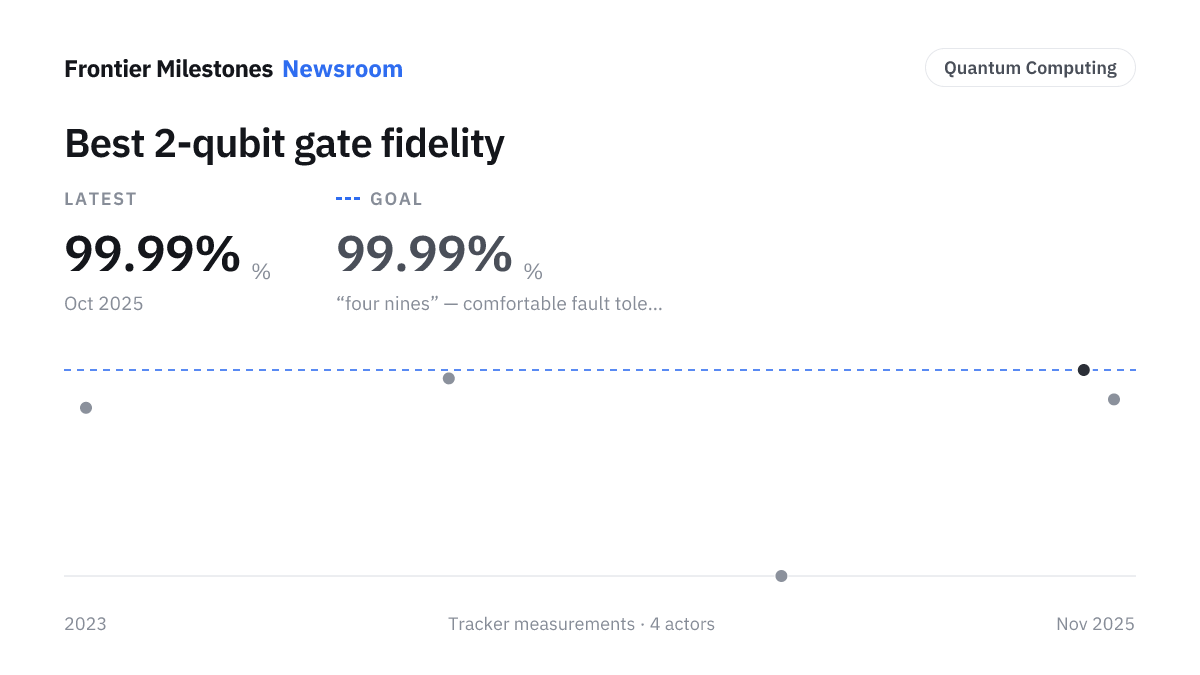
99.9% vs 99.99% looks like a rounding error but means 10× fewer mistakes. Error correction only pays off above a threshold near “three nines”; crossing “four nines” buys real headroom.

 Atom Computing
 IBM
 QuEra
 Quantinuum