Tesla's third-quarter letter said Optimus production has started at Fremont, in a process it called suitable for a commercial product, but gave no delivery date. On the October 21 call Musk called it early production, put deliveries to customers outside Tesla around the end of 2027, and said hands, durability and AI still need work. Reaching 20,000 units a week would take at least a year.
Elon Musk confirmed on October 3–4 that TSMC is in discussions about Terafab, the roughly $119 billion chipmaking venture meant to supply only Tesla, SpaceX and xAI. Under the structure reported, SpaceX would hold the majority and TSMC would build and operate the plant with its own process. Intel, currently the named supplier of its 14A process, fell 4%. Musk: "Just discussions, but something may come of it."
Mercedes-Benz signed a production agreement on September 22 to put the Wayve AI Driver in its cars within two years. On October 1 Der Spiegel reported, citing three insiders, that Volkswagen chose Wayve as its automated-driving partner after testing it against Nvidia and others. With Nissan and Stellantis already signed, the UK start-up is becoming the driving software that carmakers without their own stack license.
The Information reported that Optimus output rose from a few dozen a week in Q2 to several hundred a week by August, with a target of more than 1,000 a week by year end and an eventual 20,000. The same reporting found the hands still assembled by hand, most units used internally for testing and data, and the factory units confined to supervised areas on set tasks. Tesla has still not published a production figure.
Waymo reported a fatal Dallas crash to NHTSA: its vehicle was slowing for a pedestrian in the roadway when an SUV struck that pedestrian, sending them into the Waymo's rear left side. Juan Guzman, 71, died. It is the only Texas fatality in NHTSA's robotaxi database since June 2025, and the causal order is the part the headline cannot carry.
UBTECH began production on 12 September at a 14,000 m² plant in Liuzhou designed for more than 10,000 humanoid robots a year, building Walker S and Cruzr industrial units with Siemens as manufacturing-software partner. It states a line rate — one robot every 10 minutes — which is the first such figure in a month of production announcements from Tesla, AgiBot, XPeng and now UBTECH.
Sand-coloured Cybercabs without side mirrors have been spotted across New York City — with a person behind a steering wheel. NYC's transportation department says Tesla is testing a supervised self-driving system there, a different configuration from the Austin cars, which genuinely have no wheel or pedals. Separately, about 45 Cybercabs are registered in Texas, against the roughly 1,000 covered by NHTSA's audit.
XPeng switched on what it calls the world's first automated production line for advanced humanoids, with over 80% of core processes automated, and an IRON unit walked off it under its own power. XPeng's own timetable still puts mass production at end-2026, first deployments in its own stores, and commercial deliveries in 2027. Several outlets reported it as production having begun.
Tesla began charging for Cybercab rides in Austin on 3 September, the first paying service in a vehicle built with no steering wheel, pedals or mirrors. Hours later NHTSA opened Audit Query AQ26002 across roughly 1,000 Cybercabs, asking whether Tesla properly self-certified a car with no controls against crash standards written for conventional vehicles.
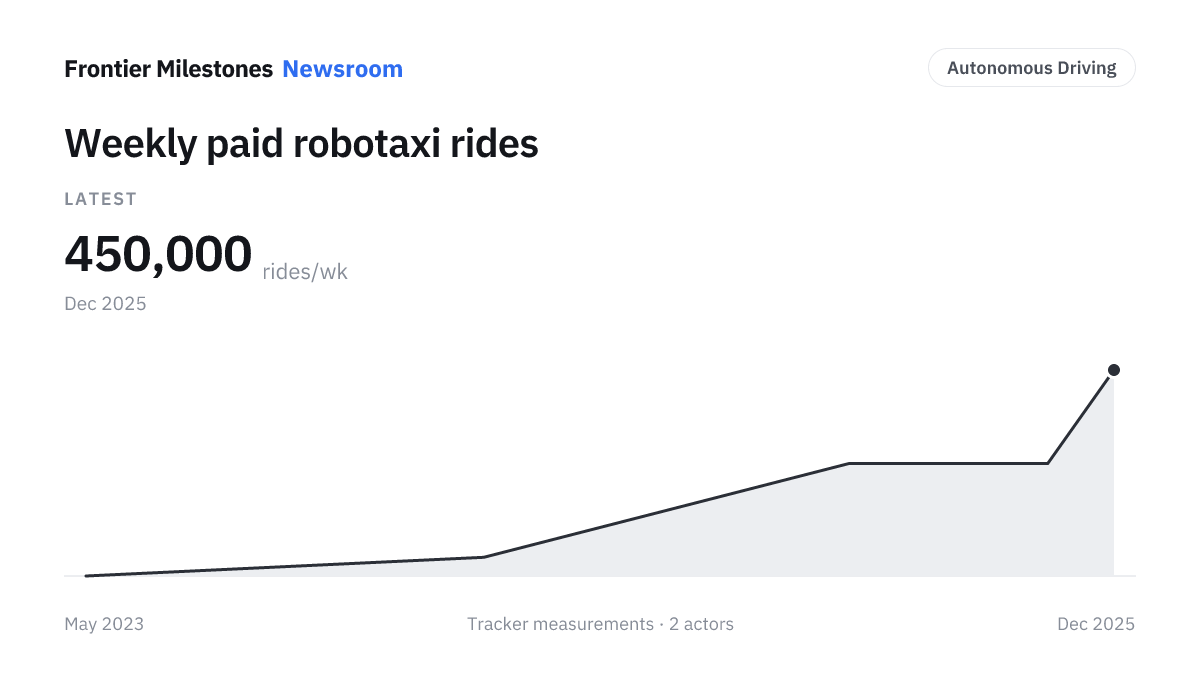
Waymo runs 450,000 paid driverless rides a week on 200 million rider-only miles, and 2026 brought the field's first paid rides with no steering wheel, a London licence — and its first real setbacks: a 3,791-vehicle recall, a freeway pause, and China's first nationwide permit freeze.
Tesla — Cybercab, Austin, Texas — Tesla began charging fares for Cybercab rides in Austin on 3 Sep 2026 — the two-seater is built with no steering wheel, no pedals and no mirrors, making it the first purpose-built driverless vehicle to carry paying passengers at scale. There was no launch event: a small group of shareholders and friendly accounts rode first, then the Robotaxi app opened more widely. The same day, NHTSA opened Audit Query AQ26002 covering roughly 1,000 Cybercabs — the self-certified population, not the deployed fleet; about 45 were registered in Texas at launch — asking whether Tesla followed the proper process in self-certifying a car with no controls against crash standards written for conventional vehicles. An audit query is not a recall or a finding of danger — it is a question about the paperwork that made the deployment legal.
A Tesla Model 3 was stopped on the eastbound Loop 202 in Mesa, Arizona at about 3 a.m. when a Ford F-350 struck it from behind, killing the driver. Tesla's own telematics marked the automation "Verified Engaged" — Autopilot or FSD was active. It is the second such death in weeks, after a near-identical Florida case, and investigators did not know the system was on.
The Nevada Transportation Authority granted Tesla an autonomous-vehicle network permit but capped the fleet at 10 vehicles against the 5,000 Tesla sought for its first year. Operations are confined to the Las Vegas Strip corridor below 45 mph, airport pickups are barred, cars must be labelled, and trips require 'appropriate human supervision.'
Tesla — Fremont, California — Optimus entered production at Fremont in late July/August 2026, in the floor space vacated by the Model S and Model X lines — Tesla tore those down in about 46 days after the last cars were built in early May. Musk had committed to the timing on the Q1 2026 earnings call and afterwards described the ramp as painfully slow, calling this year's rate "literally impossible to predict" given roughly 10,000 unique parts on an entirely new line. Treat the start, not the scale, as the fact here: Tesla has never published an Optimus production count, no per-unit figure has been disclosed for Fremont, and outside estimates of about 1,000–1,200 units across Fremont and Giga Texas are unconfirmed by the company. In late September The Information reported a rate, still not from Tesla: a few dozen units a week in Q2 rising to several hundred a week by August, with managers aiming for a continuous automated line above 1,000 a week by year end and an eventual 20,000 a week. The same reporting described the hand and forearm — more than 100 screws and small parts — as still assembled by hand, and most units as used internally for testing, training and data collection; those working in Tesla factories are confined to controlled, supervised areas on specific tasks, and Tesla acknowledged the robots remain far from general-purpose work. Tesla's Q3 letter (Oct 2026) said Fremont production had started in a process suitable for a commercial product but gave no delivery date; on the 21 Oct call Musk called it early production, put deliveries to customers outside Tesla around the end of 2027, named hands, durability and AI as unsolved, and said 20,000 a week was at least a year away. Production has started; a deliverable product has not.
NHTSA opened a special investigation into a fatal Texas crash involving Tesla's driver assistance, the family sued, senators demanded accountability, and Tesla settled a separate fatal-crash FSD lawsuit — all within days of the Miami robotaxi launch. Our read: the regulatory overhang is now the variable to price.
Our read — labelled opinion, not investment advice.
Tesla opened its unsupervised robotaxi service in Miami, its first city outside Texas and California — a geofenced zone across West Miami, Doral and Coral Gables including the MIA airport, running Model Ys.
Tesla — Tesla began public Austin robotaxi rides with no human safety monitor in the car (22 Jan 2026); by June it covered the entire Austin metro (~245 sq mi, ~13–20 Model Ys), though remote operators can still intervene.
 TSMC
 Intel
 SpaceX
 Wayve
 NVIDIA
 Waymo
 UBTECH Robotics
 XPeng
 Zoox