Google Quantum AI reported in Science on October 15 the first hardware demonstration of magic state cultivation, on its Willow processor: magic states at a fidelity of at least 0.9999, with errors about 40 times lower than uncultivated states, keeping roughly 8% of attempts. Magic states enable the non-Clifford gates useful algorithms need, and making them was expected to eat most of a fault-tolerant machine.
Google Quantum AI — Willow processor (Science) — Google reported in Science on 15 Oct 2026 the first hardware demonstration of magic state cultivation on its Willow processor: magic states prepared at a fidelity of at least 0.9999, with errors about 40 times lower than uncultivated states, keeping roughly 8% of attempts. Magic states are the resource that lets an error-corrected machine perform the non-Clifford gates every useful algorithm needs, and producing them has been expected to consume most of a fault-tolerant computer's hardware. Cultivation, proposed by Craig Gidney and colleagues in 2024, grows them in place far more cheaply than the older distillation factories. This is a peer-reviewed component result, not a fault-tolerant computer: Google's next step is to run cultivation at larger scale.
Bechtel is leaving TerraPower's Natrium plant in Kemmerer, Wyoming, after the two companies could not agree on the project's next phase; a WARN notice filed September 15 covers about 200 positions. TerraPower will rebid the EPC contract and says the 2030–31 schedule holds. The same week Samsung C&T put up to $100M into Kairos Power and joined the Hermes 2 build.
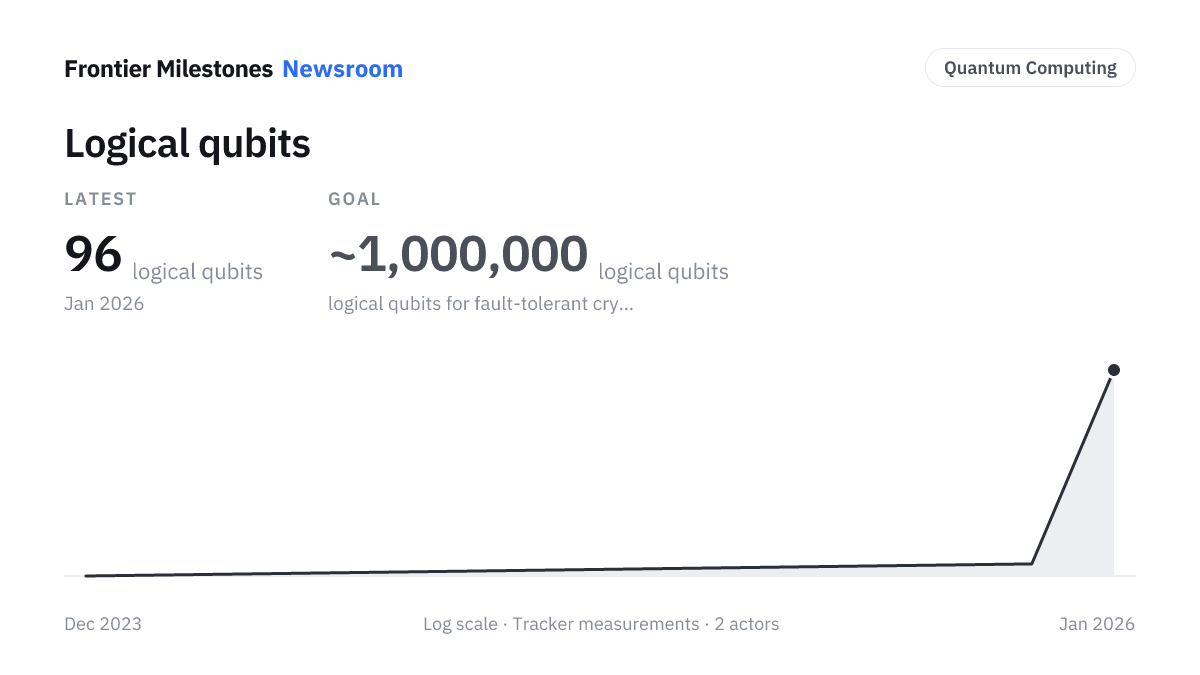
Error correction stopped being a promise in 2026 — 96 logical qubits, an 800× logical-to-physical gap, a 2:1 encoding ratio. The machine that breaks RSA still needs thousands of logical qubits. A read of every quantum number this tracker holds.
For decades, adding qubits added errors faster than you could correct them. “Below threshold” is the turning point where making the code bigger makes it more reliable — the precondition for a useful machine.

 TerraPower
 Kairos Power
 QuEra
 Quantinuum
 IonQ