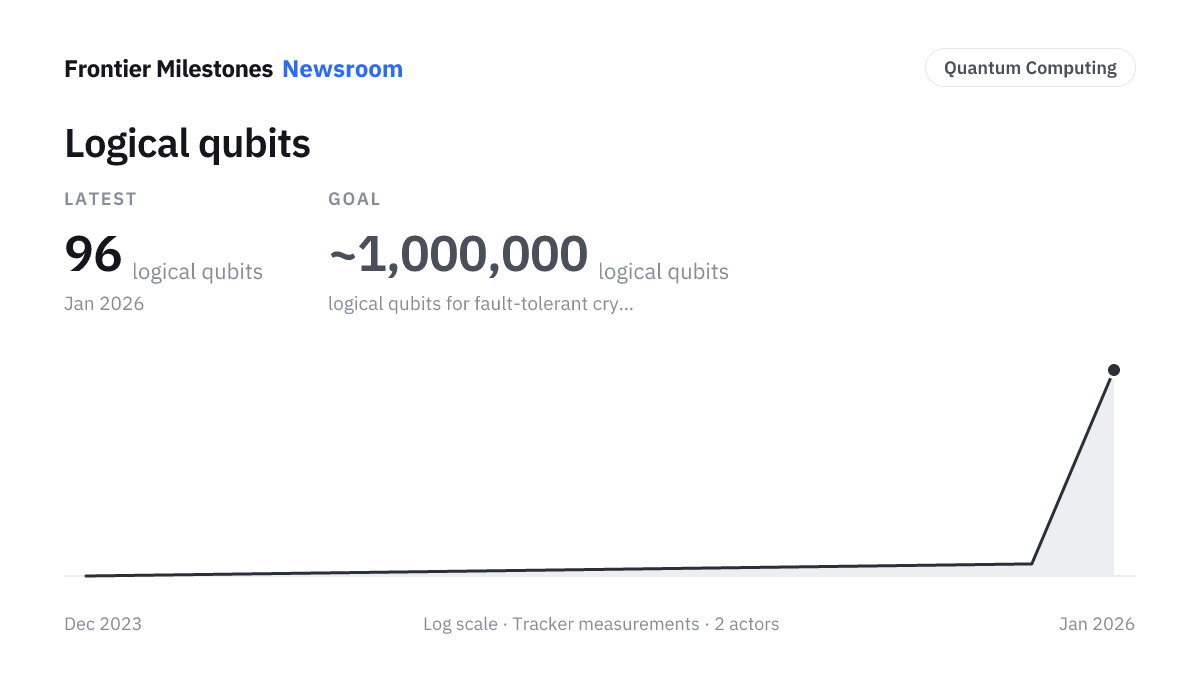
Error correction stopped being a promise in 2026 — 96 logical qubits, an 800× logical-to-physical gap, a 2:1 encoding ratio. The machine that breaks RSA still needs thousands of logical qubits. A read of every quantum number this tracker holds.
IBM / HRL Laboratories (from Boeing and GM) — IBM completed its acquisition of HRL Laboratories on 26 Aug 2026, adding silicon-spin qubits to a roadmap built entirely on superconducting transmons, along with HRL's quantum sensing, cryogenics, control electronics and packaging work. Boeing and General Motors, HRL's former owners, stay on as partners. Terms were not disclosed. Silicon spin qubits are the modality that could ride existing semiconductor fabs, which is why IBM ties it to Anderon, its quantum wafer foundry — but this buys a research program, not a working machine: IBM's shipping systems remain superconducting.
IBM, with partner Qedma and separately the University of Chicago, says it demonstrated quantum advantage with trust: modeling quantum-material physics on up to 74 qubits that no classical method has reliably reproduced in eight months — while providing evidence the results are correct even when classical verification is unavailable. The trust framework, not raw speed, is the claimed advance.
IBM signed a definitive agreement to acquire HRL Laboratories — the R&D institution jointly owned by Boeing and GM — to add silicon spin-qubit expertise alongside its superconducting roadmap. Price undisclosed; HRL's chips will move to IBM's New York fab. It's a two-track quantum bet toward IBM's Starling (2029) and Blue Jay (2033) systems.
IBM Research — IBM demonstrated the world's first sub-1nm (0.7nm / 7Å "nanostack") logic transistor architecture, experimentally validated at the 2026 VLSI Symposium with functional CMOS inverters and ~100B transistors on a fingernail-sized die. A research milestone — not a product: IBM is still scaling 2nm and sees production as early as ~5 years out. (Aggregator coverage conflated this with the separate 'Anderon' quantum-chip foundry plan.)
IBM / US Commerce — IBM is spinning off Anderon, a $2B (≈$1B CHIPS Act + $1B IBM) 300mm superconducting-qubit wafer fab in Albany, NY — open to other quantum vendors as a neutral 'TSMC for quantum.'

 QuEra
QuEra  Quantinuum
  IonQ
IonQ