Reuters reported on 16 September that SK hynix is in talks with Intel about manufacturing memory chips in the US for the first time — options include leasing part of Intel's Ohio complex or a venture with Intel and cloud buyers. Two weeks ago SK hynix denied a report that it was weighing Intel Foundry for HBM4E base dies. Both can be true: they are different deals.
All three leaders reached 2nm-class volume in 2025, but TSMC holds about two-thirds of the foundry market and spends ~$40B a year to keep it. IBM demonstrated a sub-1nm transistor in 2026 — a research result roughly five years from production.
Herald Economy reported that SK hynix is considering Intel Foundry as a second source for the base dies under its HBM4E stacks, work that currently runs entirely through TSMC. SK hynix said it is not currently considering Intel for HBM4E, calling parts of the report inaccurate without specifying which.
SK hynix approved about ₩54 trillion ($38B) of investment — ₩35.2tn for the Yongin Y2 fab and ₩19.1tn for Cheongju M17. Cleanrooms open in December 2028 (M17) and June 2029 (Y2), executing the mid-to-long-term plan the company set out in June.
Industry reports say Samsung, SK hynix and Micron have booked out their entire 2027 DRAM and HBM capacity, closing allocation talks months ahead of schedule. Buyers are reportedly receiving only 60–70% of requested volumes and are locking supply through three-to-five-year agreements with advance deposits.
Nvidia and SK Group announced a $500B+ initiative spanning AI data centers and next-gen memory. It pairs a long-term SK hynix HBM4 supply-and-co-development partnership with an SK Telecom 2GW data center (Vera Rubin chips, HBM4) online from 2027, plus Naver/Brookfield and Hyundai Genesis autonomy tie-ups. Samsung is also in on chip/memory design.
SK hynix began trading on Nasdaq at $149, raising about $26.5B — the biggest-ever US equity debut by a foreign company (past Alibaba's $25B in 2014) and the second-largest share sale on record. Proceeds fund fabs and equipment for AI memory.
SK hynix will invest 100 trillion won (~$64B) in new plants at Cheongju — ₩80T for the M17 NAND fab targeting 2029 and ₩20T for a packaging facility by late 2027 — under Korea's broader AI-chip investment drive.
South Korea unveiled a government-led national plan pledging over $576B across semiconductors, AI data centers and physical AI — anchored by Samsung and SK hynix, who will each build two new HBM-focused fabs. This confirms an earlier ~$646B report (a separate framing of Samsung group capex).
 Intel
Intel 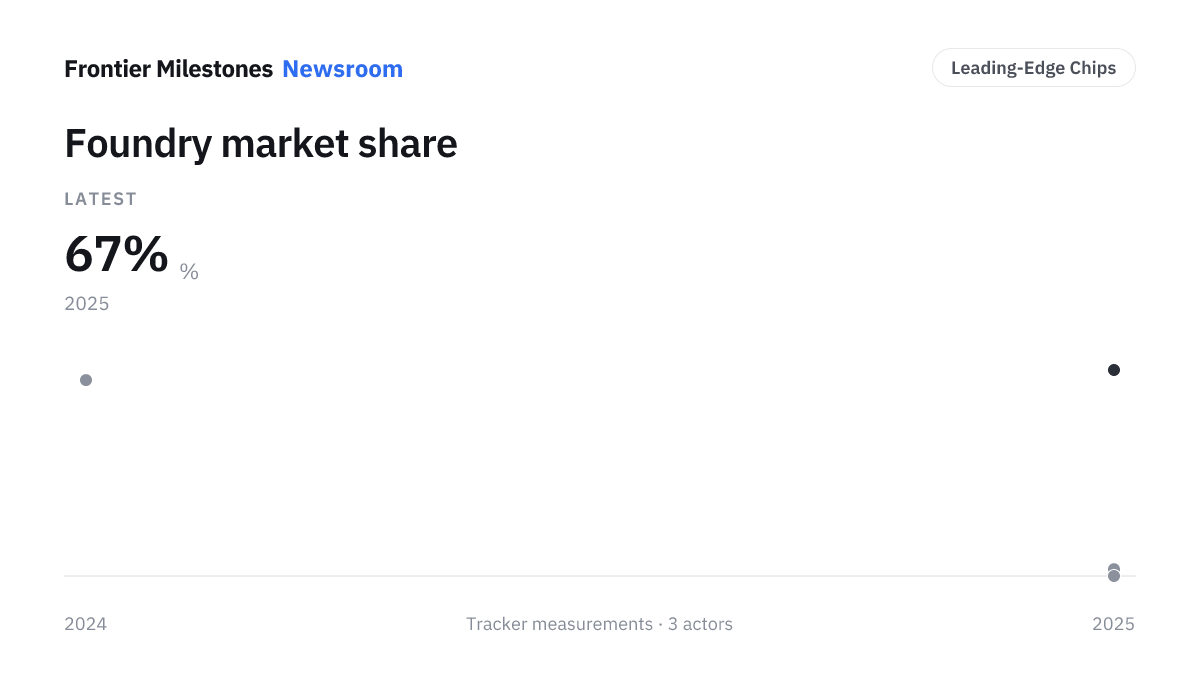
 TSMC
TSMC  Samsung Foundry
  Micron
  NVIDIA