Reuters reported on 16 September that SK hynix is in talks with Intel about manufacturing memory chips in the US for the first time — options include leasing part of Intel's Ohio complex or a venture with Intel and cloud buyers. Two weeks ago SK hynix denied a report that it was weighing Intel Foundry for HBM4E base dies. Both can be true: they are different deals.
TSMC and Samsung committed to ASML's High-NA EUV scanners, Samsung by 2028 and TSMC by 2030, closing the question of whether the leading foundries would adopt the tool. Intel is already running it. The same week all three joined an ASML initiative to move photomasks from 6-inch to 12-inch, targeting a pilot line in 2031 — because today's mask size costs High-NA about 30% of its throughput.
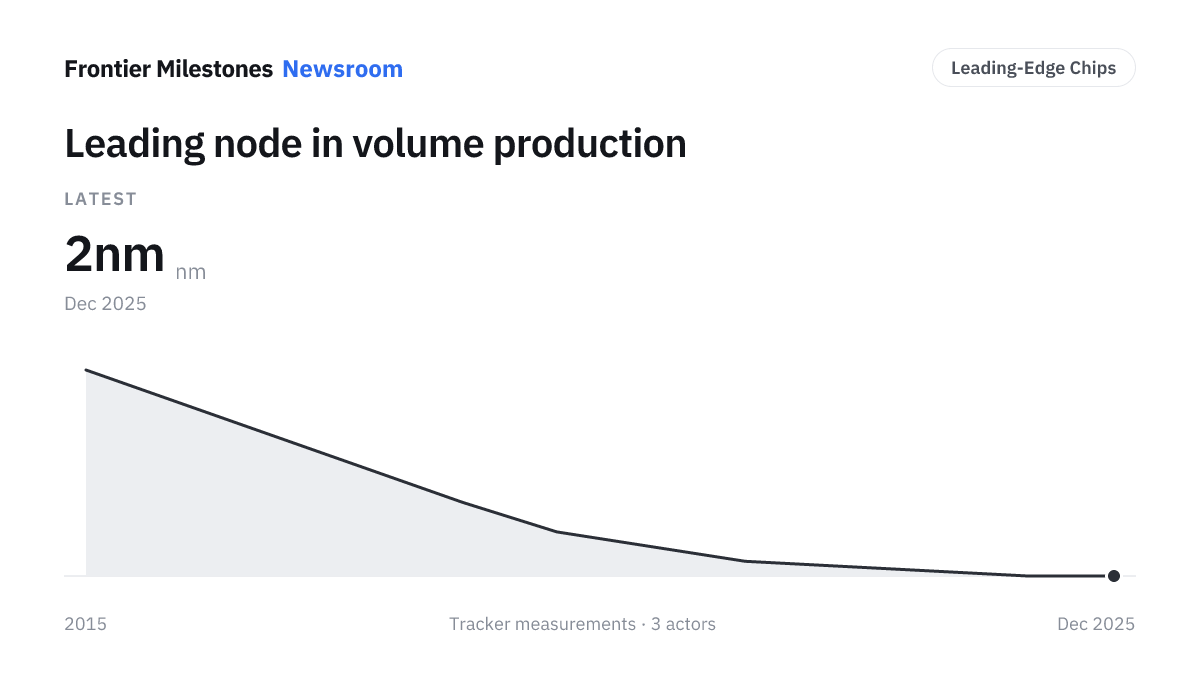
All three leaders reached 2nm-class volume in 2025, but TSMC holds about two-thirds of the foundry market and spends ~$40B a year to keep it. IBM demonstrated a sub-1nm transistor in 2026 — a research result roughly five years from production.
Herald Economy reported that SK hynix is considering Intel Foundry as a second source for the base dies under its HBM4E stacks, work that currently runs entirely through TSMC. SK hynix said it is not currently considering Intel for HBM4E, calling parts of the report inaccurate without specifying which.
Intel priced 210.5 million shares at $95, upsizing the offering from $15B to $20B for about $19.7B net. Institutional demand topped $100B — roughly 5x the book. Proceeds fund foundry and AI-chip manufacturing; 2026 capex guidance rises above $20B, and existing holders take about 4.9% dilution.
Intel reported Q2 revenue of $16.1B, up 25% year over year — its fastest growth since 2011 — with adjusted EPS of 42¢ doubling the 21¢ expected. Data Center & AI revenue jumped 59% to $6.3B. Q3 guidance ($15.8–16.8B) came in well above estimates, and shares rose after hours.
Fortinet became the first named external Intel Foundry customer since Lip-Bu Tan took over, with a firewall ASIC built on the Intel 4 process. Intel shares jumped more than 8% two days before Q2 earnings. It's a real proof point — but on a mature node, not the leading-edge 14A the turnaround thesis rests on.
ASML lifted 2026 revenue guidance to €43–45B (from €36–40B, +16% at midpoint) after a Q2 beat (€9.33B revenue, €2.92B net), and will expand low-NA EUV and DUV immersion capacity by 30% each. Intel becomes the first to make chips (Panther Lake) on its High-NA tool.
Intel announced a €5B (~$5.7B) expansion of its Leixlip, Ireland campus — upgrading fabs and installing leading-edge tools to scale Intel 3 output for Xeon 6 and next-gen server chips, citing AI and HPC demand. Total Irish investment tops €30B.
Intel CEO Lip-Bu Tan broke ground on a 107,000 sq ft Bowers Campus expansion — two manufacturing buildings supporting EUV photomask production for the 18A-P and 14A nodes, timed ahead of the US 35% investment-tax-credit deadline.
Intel / Apple — President Trump said (on Truth Social, 18 Jun 2026) that Apple has agreed to work with Intel on US chip design and manufacturing — sending Intel up ~9%. It follows a WSJ report of a preliminary deal after a year of talks, with Intel likely starting on simpler M-series parts before iPhone silicon, helping Apple diversify from TSMC. Neither company has confirmed scope, timing or structure — so this remains unconfirmed.
TSMC holds ~two-thirds of the market and the yield lead; Intel is betting its comeback on 18A; Samsung trails on yield. Our read on a race where one player's dominance keeps compounding. (Our opinion, not investment advice.)
Our read — labelled opinion, not investment advice.
No part of a "2nm" chip is 2 nanometers. Node names are marketing labels, not physical measurements — so we read them alongside transistor density and who is actually shipping in volume.
 SK hynix
  ASML
ASML  TSMC
TSMC 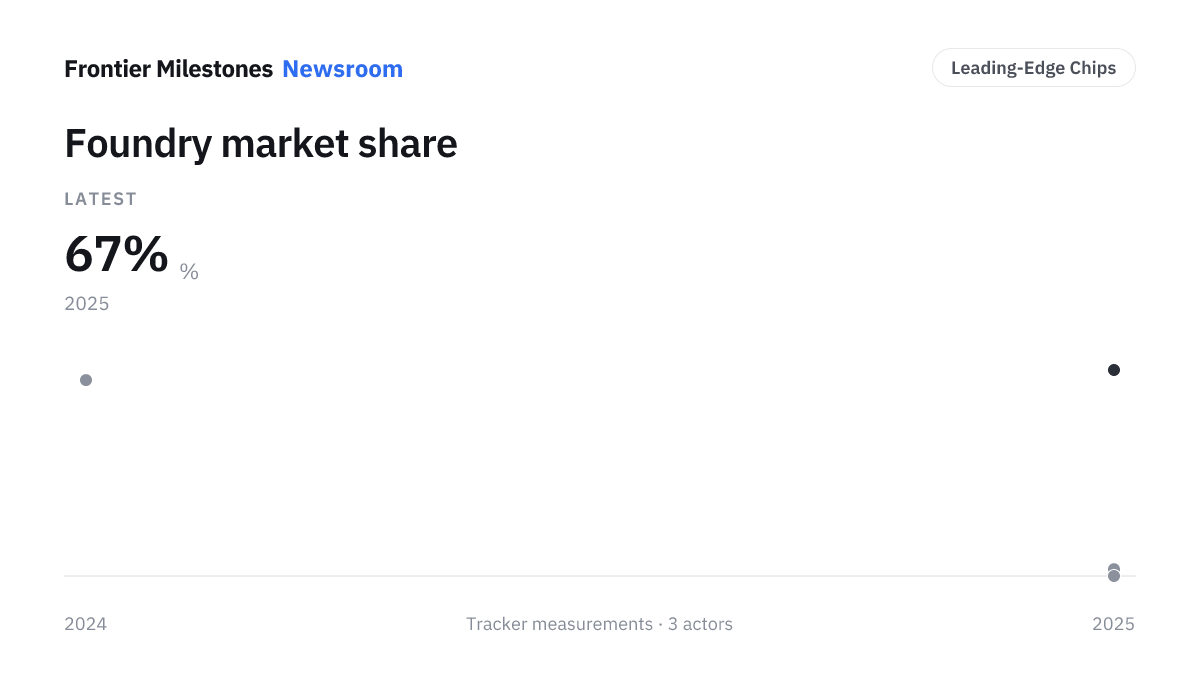
 Samsung Foundry